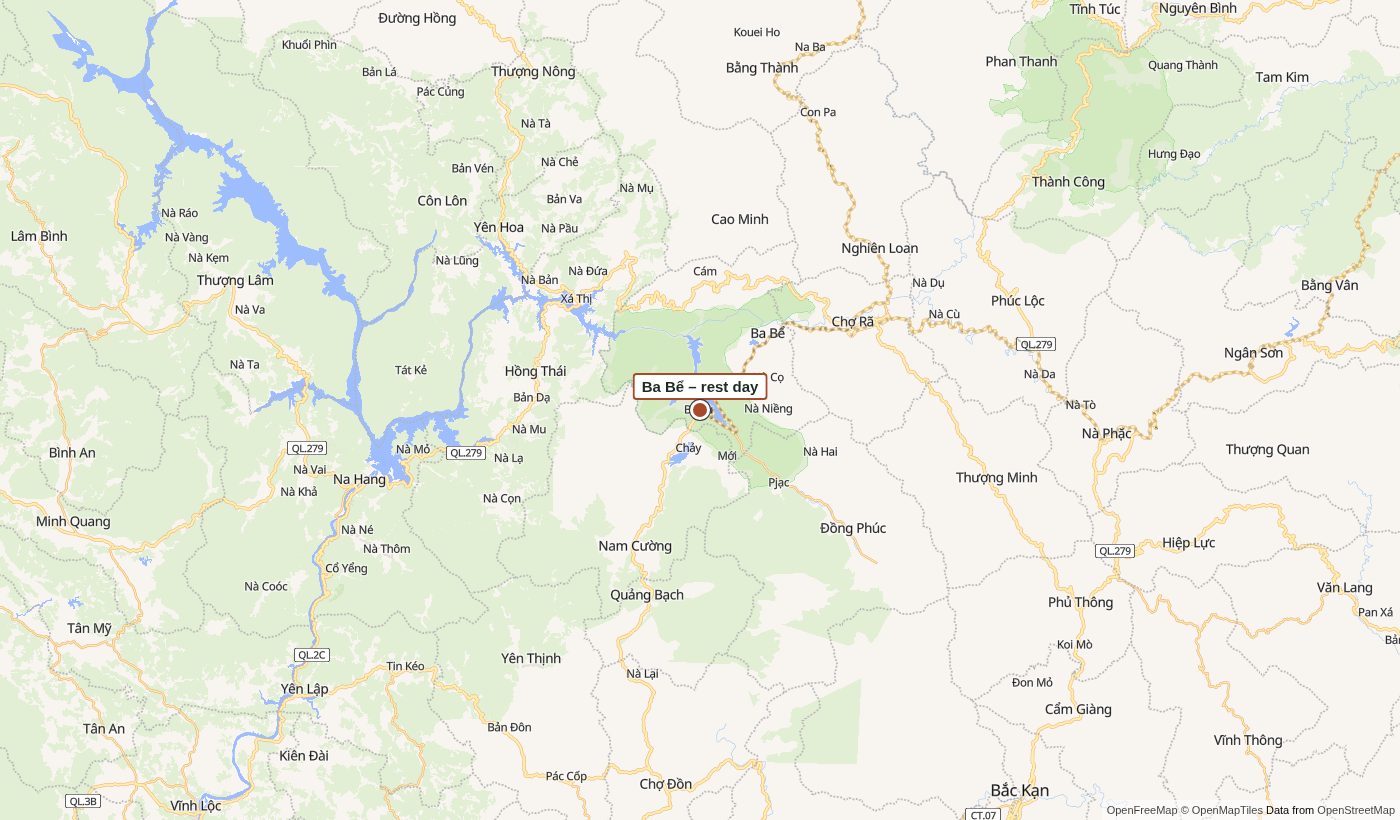
Setting
Ba Bể is the largest natural freshwater lake in Vietnam. It is about 8 km long and up to 500 m wide, lies 178 m above sea level and is ringed by limestone forest.
Story
The national park was declared an ASEAN Heritage Park in 2004 and a Ramsar wetland of international importance in 2011. A local Tày legend says the lake was made by a flood sent to punish a village that refused to help a beggar. Only a widow who helped him was spared, on what is now the island of Pò Giá Mải.
People
Tày (the stilt houses at Pác Ngòi) and Dao.
What makes it special
By boat you can reach Puông cave, where the river runs through a mountain, and the Đầu Đẳng rapids. You can also stay overnight in a Tày stilt house on the lakeshore.
The peoples in more detail
Along the way: Tày (Pác Ngòi stilt houses), Dao.
Tày (Thổ, old name)
Valley rice farmers who live in timber stilt houses and wear plain indigo-dyed clothes. They are the majority in Bình Liêu and have lived around Ba Bể for about 2,000 years; Pác Ngòi is a Tày village.
Food: Sticky rice was once the staple, and most homes still have a steamer for it.
Dao (Yao, Mien)
A large group with many branches, each with its own dress. In Bình Liêu you'll see Dao Thanh Y and Dao Thanh Phán, around Ba Bể the Dao live on the hillsides, at Bắc Hà market Black Dao come in, and in Sa Pa and Hoàng Su Phì there are Red Dao, with red pom-pom headdresses.
Food: Two main meals a day, of rice or, in some places, maize or rice porridge.
Military history and figures
Military history
There are no major battles at the lake itself. The surrounding Bắc Kạn–Thái Nguyên–Tuyên Quang hills formed the Việt Bắc “safe zone” (ATK) from which the Việt Minh government ran the war in 1947–54, and the Léa operation of 1947 swept the area.
Linked figures
None specific to the lake. The Việt Bắc leadership as a whole (Hồ Chí Minh, Trường Chinh, Phạm Văn Đồng, Giáp) is linked to the region.