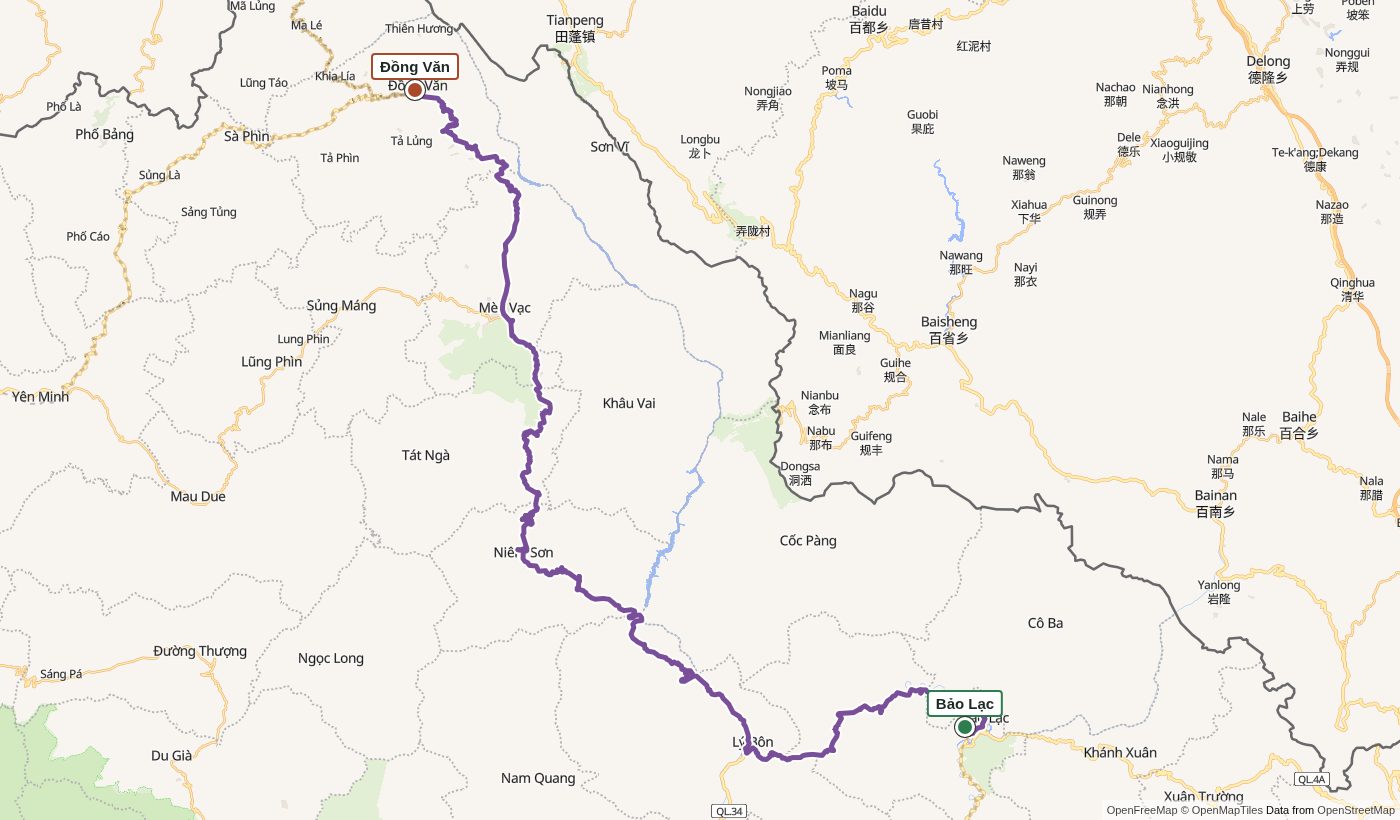
Setting
You enter the Đồng Văn Karst Plateau UNESCO Global Geopark. This is an upland of bare grey limestone at 1,000–1,600 m, cut by the Nho Quế river. Tu Sản canyon is the deepest in Vietnam. Mã Pí Lèng pass runs along its rim at about 1,200 m.
Story
Mã Pí Lèng is counted among the “four great passes” of the north, along with Ô Quy Hồ, Khau Phạ and Pha Đin. The road along it, the “Happiness Road”, was cut largely by hand by young volunteers between 1959 and 1965. Mèo Vạc, on the way, is home to the Khâu Vai “love market”, held once a year.
People
Hmong, Lô Lô (around Mèo Vạc), Dao and Giáy.
What makes it special
The rocky plateau is one of the harshest farmed landscapes anywhere. Maize is planted in pockets of soil between the rocks. Mã Pí Lèng is one of the great rides of Asia.
The peoples in more detail
Along the way: Hmong, Lô Lô (Mèo Vạc), Dao, Giáy.
Hmong (H'Mông, Mèo, old name, now avoided)
The people you'll see most in the high country. They make up about 72% of the Đồng Văn plateau and about half of Sa Pa, and Mường Lống is entirely Hmong.
Food: Two meals a day, three at harvest.
Lô Lô (Yi)
A small group whose costumes are made of large blocks of coloured patchwork and appliqué, with some beeswax-printed patterns. There are two branches, the Flower Lô Lô and the Black Lô Lô.
Food: Steamed maize flour is the staple, and every meal must include a soup, eaten from wooden bowls with wooden spoons.
Dao (Yao, Mien)
A large group with many branches, each with its own dress. In Bình Liêu you'll see Dao Thanh Y and Dao Thanh Phán, around Ba Bể the Dao live on the hillsides, at Bắc Hà market Black Dao come in, and in Sa Pa and Hoàng Su Phì there are Red Dao, with red pom-pom headdresses.
Food: Two main meals a day, of rice or, in some places, maize or rice porridge.
Giáy (Nhắng)
Skilled terrace rice farmers. Women wear indigo trousers and a long five-panel jacket that fastens under the right arm, with their hair wound round the head and pink threads at the ends.
Food: Plain rice that is part-boiled and then steamed like sticky rice.
Military history and figures
Military history
- Hà Giang frontier, 1979–89. The Mèo Vạc and Đồng Văn districts are on the frontier that was fought over in 1979 and again in the 1980s.
- Mã Pí Lèng. The pass road, the “Happiness Road”, was built by hand by volunteer youth in 1959–65. It was a civilian project, but strategic too, because it tied the plateau to the provincial capital.
Linked figures
The road builders are commemorated at the Mã Pí Lèng monument.