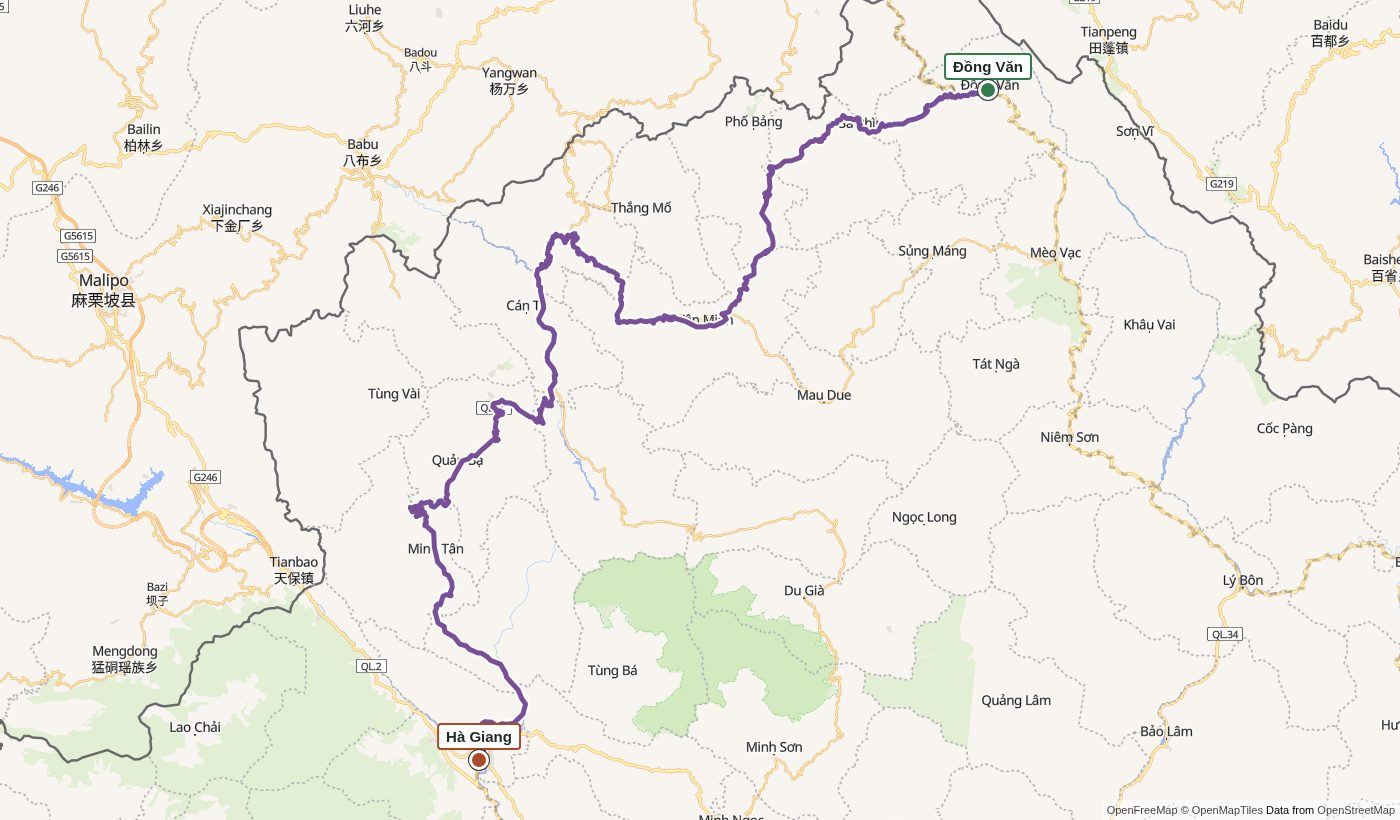
Setting
The road crosses the plateau through Sà Phìn, Yên Minh and Quản Bạ and comes down through Heaven Gate, at about 1,500 m, to the Lô river valley at Hà Giang.
Story
At Sà Phìn the Vương (Hmong king) family palace was built between 1898 and 1903 for Vương Chính Đức. He was the Hmong chief who controlled the plateau and its opium trade under the French. The stone and timber palace mixes Hmong, Chinese and French architecture. From Quản Bạ Heaven Gate you look down over the valley and the “Twin Mountains” (Núi Đôi) of local legend.
People
Hmong (Vương Palace), Pu Péo, Giáy, Bố Y, Cờ Lao, Dao and Tày.
What makes it special
The Vương palace is the best surviving reminder of the opium-financed “kings” of the highlands. Heaven Gate gives the classic last look back at the rocky plateau.
The peoples in more detail
Along the way: Hmong (Vương Palace), Pu Péo, Giáy, Bố Y, Cờ Lao, Dao, Tày.
Hmong (H'Mông, Mèo, old name, now avoided)
The people you'll see most in the high country. They make up about 72% of the Đồng Văn plateau and about half of Sa Pa, and Mường Lống is entirely Hmong.
Food: Two meals a day, three at harvest.
Pu Péo (Ka Beo)
One of Vietnam's smallest groups, almost all of them on the Hà Giang plateau. Like the Lô Lô, they keep pairs of 'male' and 'female' bronze drums.
Food: Steamed maize flour and soup, which is sipped with a spoon.
Giáy (Nhắng)
Skilled terrace rice farmers. Women wear indigo trousers and a long five-panel jacket that fastens under the right arm, with their hair wound round the head and pink threads at the ends.
Food: Plain rice that is part-boiled and then steamed like sticky rice.
Bố Y
A very small group that came from China about 150 years ago. They live in earth-walled houses with tiled or wooden roofs.
Food: Mèn mén, steamed ground maize, like their Hmong neighbours.
Cờ Lao (Gelao)
A very small group in Hà Giang. On the rocky plateau they grow maize in pockets of soil between the limestone, with ash and manure worked into each planting hole.
Food: Maize as mèn mén, or rice, eaten from wooden bowls with wooden spoons and ladles.
Dao (Yao, Mien)
A large group with many branches, each with its own dress. In Bình Liêu you'll see Dao Thanh Y and Dao Thanh Phán, around Ba Bể the Dao live on the hillsides, at Bắc Hà market Black Dao come in, and in Sa Pa and Hoàng Su Phì there are Red Dao, with red pom-pom headdresses.
Food: Two main meals a day, of rice or, in some places, maize or rice porridge.
Tày (Thổ, old name)
Valley rice farmers who live in timber stilt houses and wear plain indigo-dyed clothes. They are the majority in Bình Liêu and have lived around Ba Bể for about 2,000 years; Pác Ngòi is a Tày village.
Food: Sticky rice was once the staple, and most homes still have a steamer for it.
Military history and figures
Military history
The day passes the Vương Palace at Sà Phìn. It was built in 1898–1928 for the Hmong ruler of the plateau and fortified with stone walls and gun loops.
Linked figures
- Vương Chính Đức, who held the plateau as “King of the Hmong” (Vua Mèo) under the French.
- His son Vương Chí Sình (1886–1962). He sided with the new government after 1945, became Hồ Chí Minh’s sworn brother and gave about 9 kg of gold to the revolution. He later sat in the National Assembly.
Practical notes
- Passes the Vương Palace at Sà Phìn.