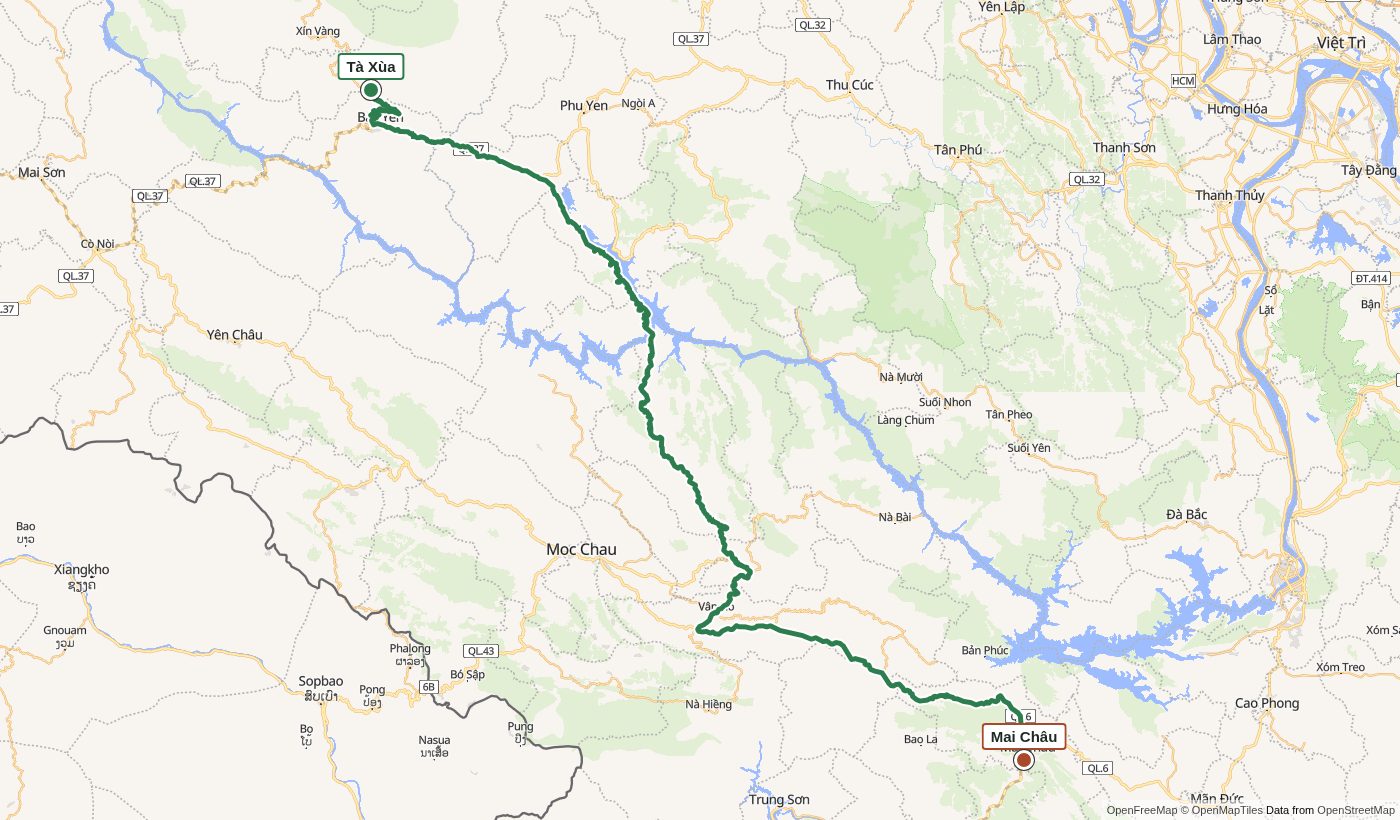
Setting
You come down from the ridge to the Mộc Châu plateau, then into the Mai Châu valley in Hòa Bình (now Phú Thọ).
Story
Mộc Châu’s tea hills were planted mainly between 1960 and 1965, when the state founded the Mộc Châu State Farm. The White Thái had grown tea here long before. The plateau is also Vietnam’s best-known dairy area.
People
Hmong, Thái, Mường and Dao (Mộc Châu, Vân Hồ).
What makes it special
The road passes from the Hmong uplands to the gentle White Thái valley of Mai Châu. You stay among stilt houses in Lác or Pom Coọng.
The peoples in more detail
Along the way: Hmong, Thái, Mường, Dao (Mộc Châu, Vân Hồ).
Hmong (H'Mông, Mèo, old name, now avoided)
The people you'll see most in the high country. They make up about 72% of the Đồng Văn plateau and about half of Sa Pa, and Mường Lống is entirely Hmong.
Food: Two meals a day, three at harvest.
Thái (Tai Dam, Tai Don)
This is the people of the Days 16–24 valleys. Black Thái live around Sơn La and Điện Biên, and White Thái around Mai Châu.
Food: Sticky rice steamed in a wooden steamer is the traditional staple, though plain rice is now the everyday grain.
Mường
The closest relatives of the Kinh, sharing the same root language. Mai Châu is a mix of Thái and Mường, and Bá Thước is one of the old Mường heartlands.
Food: Steaming is the signature technique: sticky rice, plain rice, greens and fish are all steamed.
Dao (Yao, Mien)
A large group with many branches, each with its own dress. In Bình Liêu you'll see Dao Thanh Y and Dao Thanh Phán, around Ba Bể the Dao live on the hillsides, at Bắc Hà market Black Dao come in, and in Sa Pa and Hoàng Su Phì there are Red Dao, with red pom-pom headdresses.
Food: Two main meals a day, of rice or, in some places, maize or rice porridge.
Military history and figures
Military history
In the 1952 Northwest Campaign, Việt Minh forces crossed the Đà river (7–22 November) and broke the French screen on the Mộc Châu plateau. The fall of Mộc Châu opened Route 41 (now QL6) and forced the French back on Nà Sản. Mai Châu and the Hòa Bình corridor saw fighting in the Hòa Bình campaign of the previous winter.
Linked figures
Võ Nguyên Giáp.
Practical notes
- Rejoins the Sơn La–Mai Châu road east of Mộc Châu.
- The new part of this track, as far as QL6, was drawn with a routing service and the road surface has not been checked. Ask locally the evening before.