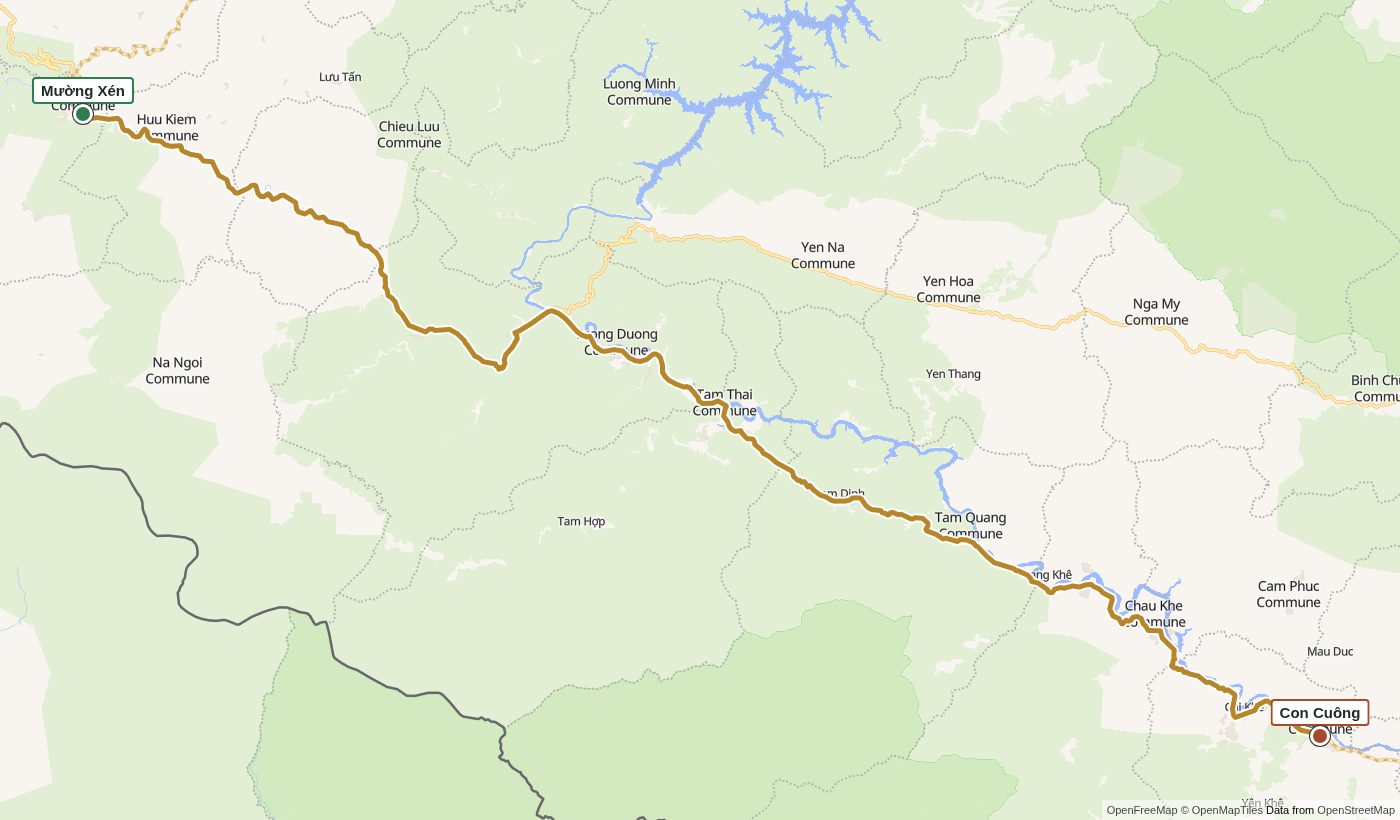
Setting
QL7 drops from the Kỳ Sơn highlands down the Nậm Mộ and Cả river gorges through Tương Dương to the wider valley at Con Cuông.
Story
QL7 is the old road from Vinh to the Nậm Cắn border crossing and on to the Plain of Jars in Laos, a strategic route since French times.
People
Hmong, Khơ Mú and Thái (Kỳ Sơn), then Thái in the valley.
What makes it special
This is a fine river-gorge ride, ending at the gate of Pù Mát National Park.
The peoples in more detail
Along the way: Hmong, Khơ Mú, Thái (Kỳ Sơn).
Hmong (H'Mông, Mèo, old name, now avoided)
The people you'll see most in the high country. They make up about 72% of the Đồng Văn plateau and about half of Sa Pa, and Mường Lống is entirely Hmong.
Food: Two meals a day, three at harvest.
Khơ Mú (Khmu)
Upland farmers known for their fine basketry in bamboo and rattan. They are about 3% of Điện Biên and the largest group in Kỳ Sơn, at about 36%.
Food: Steamed sticky rice or steamed maize, often bulked out with cassava.
Thái (Tai Dam, Tai Don)
This is the people of the Days 16–24 valleys. Black Thái live around Sơn La and Điện Biên, and White Thái around Mai Châu.
Food: Sticky rice steamed in a wooden steamer is the traditional staple, though plain rice is now the everyday grain.
Military history and figures
This section covers Days 34 and 35.
Military history
The 1424–25 campaign to liberate Nghệ An was fought largely along the Lam (Cả) valley that the road follows. Lê Lợi besieged the Ming at the Trà Lân fortress in Con Cuông, then won at Khả Lưu and Bồ Ải in today’s Anh Sơn district. After that the Ming were confined to the Nghệ An citadel.
Linked figures
- Lê Lợi.
- Nguyễn Chích.
- Đinh Lễ.
Practical notes
- Pù Mát National Park, Khe Kèm waterfall.