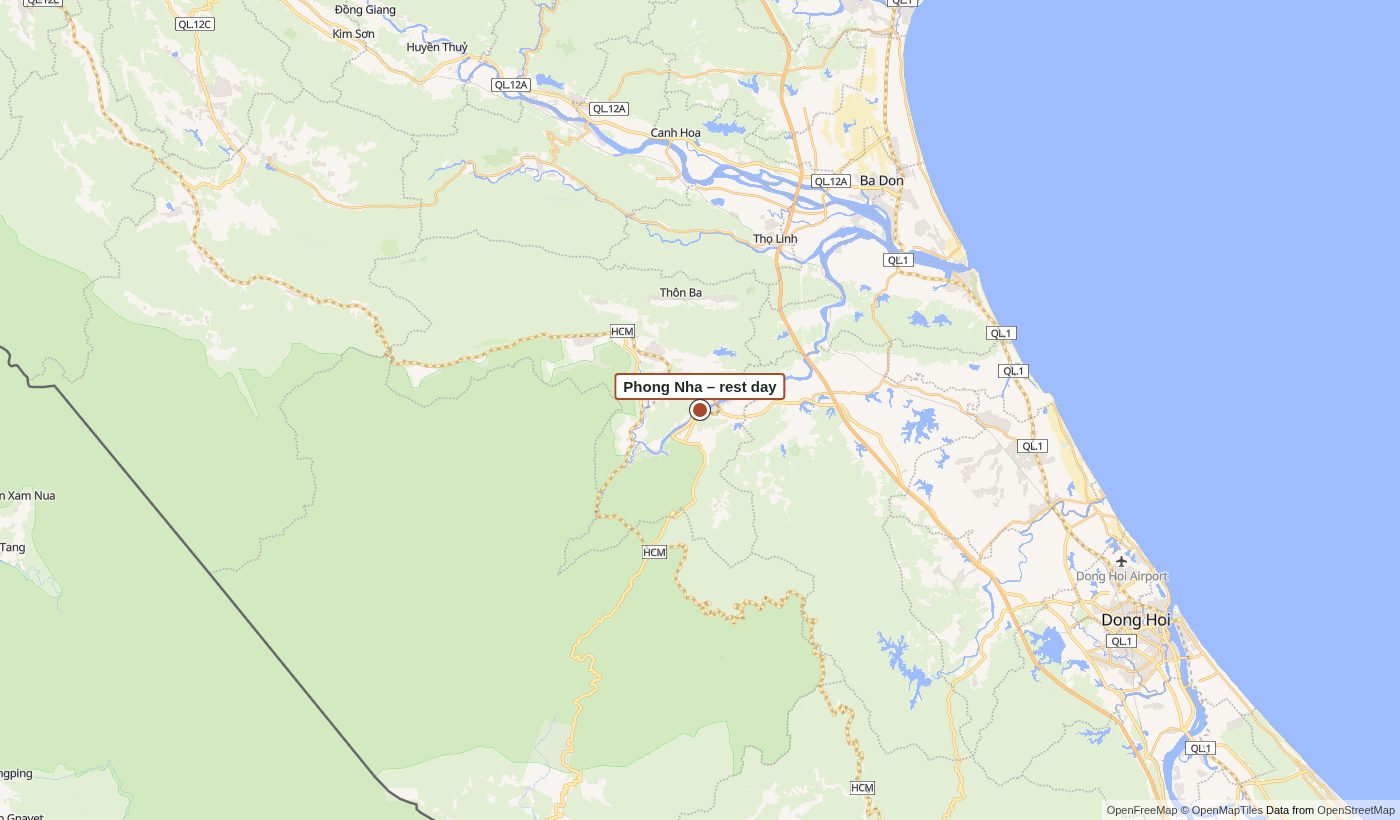
Setting
Phong Nha–Kẻ Bàng National Park protects the oldest and largest karst region in Asia: limestone mountains, underground rivers and tropical forest. The wider biosphere reserve covers 515,830 ha.
Story
UNESCO inscribed the park for its geology in 2003 and for its biodiversity in 2015. In 2025, together with Hin Nam No in Laos, it became the first transboundary World Natural Heritage site in Southeast Asia. Sơn Đoòng, the world’s largest known cave passage, was surveyed by a British Cave Research Association team in 2009. Road 20 Quyết Thắng was built between January 1965 and May 1966 to bypass the heavily bombed Route 12A. It starts at km 0 at Phong Nha and crosses the Trường Sơn, and Tám Cô cave on it commemorates eight young volunteers who died there.
People
Chứt (Arem) and Bru-Vân Kiều (Ma Coong).
What makes it special
Phong Nha has caves of every scale, and the trail history runs through the same landscape.
The peoples in more detail
Along the way: Chứt (Arem), Bru-Vân Kiều (Ma Coong).
Chứt (Sách, Mày, Rục, Arem, Mã Liềng)
A small group made up of several sub-groups, living in the limestone forests of Quảng Bình. The Rục and Arem lived mainly in caves and rock shelters until the mid-twentieth century.
Food: Maize and cassava.
Bru-Vân Kiều (Vân Kiều, Trì, Khùa, Ma Coong)
Hill farmers on both sides of the old Hồ Chí Minh Trail, many of whom now grow coffee around Khe Sanh. The Ma Coong of Thượng Trạch hold a well-known drum festival.
Food: They love grilled food and soups of greens cooked with rice and fish or frogs.
Military history and figures
Military history
- Road 20 Quyết Thắng. The road was a Hồ Chí Minh trail link and one of the most bombed in the war.
- Tám Cô cave. At km 16.5 of Road 20, eight young road builders sheltering in the cave were killed when a bomb sealed it on 14 November 1972.
Linked figures
The eight of Tám Cô.