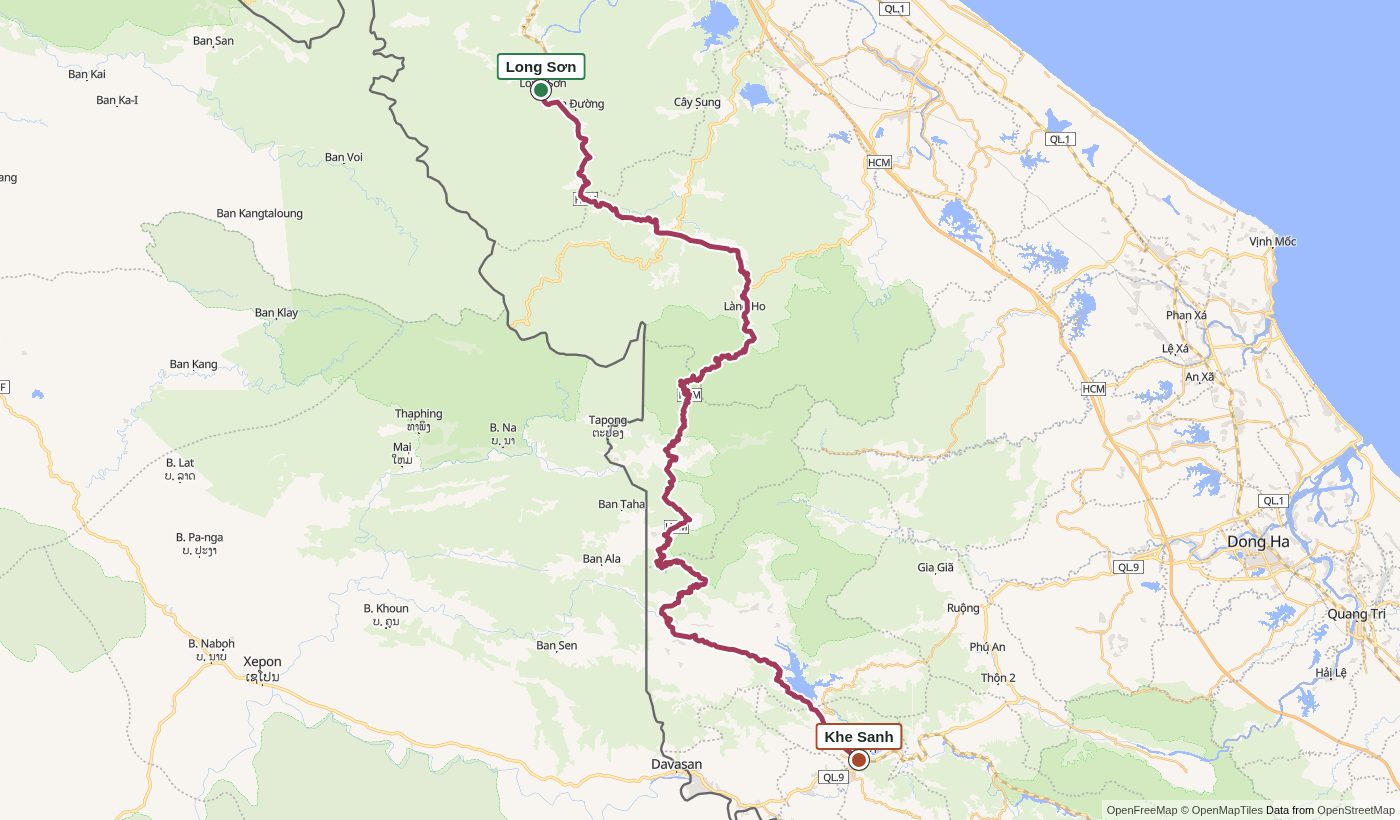
Setting
The western branch continues through Kim Ngân, Hướng Lập and Hướng Phùng to the Khe Sanh plateau near the Lao border. This is coffee and pepper country on Route 9.
Story
From 21 January to 9 July 1968 Khe Sanh saw one of the largest set-piece battles of the Vietnam War. It is still debated how it was linked to the Tết Offensive, and both sides claimed victory.
People
Bru-Vân Kiều, with Tà Ôi (Pa Kô) in Hướng Hóa.
What makes it special
You can visit the base museum at Tà Cơn and see the Lao Bảo border.
The peoples in more detail
Along the way: Bru-Vân Kiều, Tà Ôi (Pa Kô) in Hướng Hóa.
Bru-Vân Kiều (Vân Kiều, Trì, Khùa, Ma Coong)
Hill farmers on both sides of the old Hồ Chí Minh Trail, many of whom now grow coffee around Khe Sanh. The Ma Coong of Thượng Trạch hold a well-known drum festival.
Food: They love grilled food and soups of greens cooked with rice and fish or frogs.
Tà Ôi (including the Pa Kô and Pa Hy)
The main people of the A Lưới valley. Their zèng weaving, with beads worked into the cloth, is a recognised national heritage craft.
Food: Rice, topped up with maize, cassava and wild yams.
Military history and figures
Military history
- Siege of Khe Sanh, 1968. From 21 January to 9 July 1968 the US Marine combat base was besieged. Both sides claimed success, and the US abandoned the base in July.
- Làng Vây, 6–7 February 1968. The Special Forces camp fell in the first combined-arms attack with tanks (PT-76) by the People’s Army.
- Lao Bảo prison. Built in 1908, it held Cần Vương and later revolutionary prisoners.
- Route 9 – Southern Laos, 1971. From 30 January to 23 March 1971 the South Vietnamese Lam Sơn 719 offensive along Route 9 into Laos was defeated.
Linked figures
- General Võ Nguyên Giáp, who directed Khe Sanh from the north.
- General William Westmoreland, the US commander.