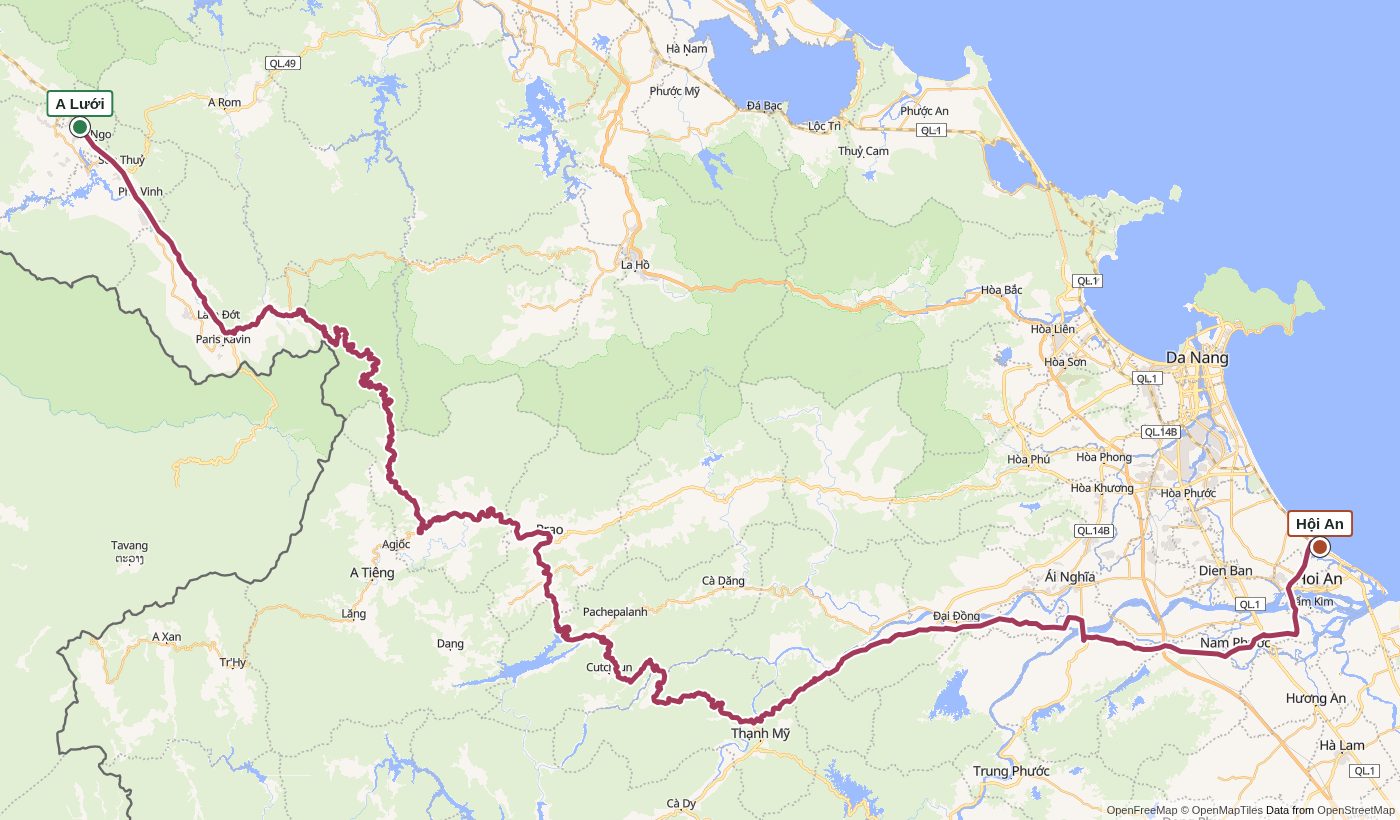
Setting
You come down from the A Lưới valley to the coast near Huế, then go over or through Hải Vân, along the Đà Nẵng coast and home to Hội An.
Story
Hội An Ancient Town was inscribed by UNESCO in 1999. It is an exceptionally well-preserved South-East Asian trading port from the 15th to the 19th centuries, used by Japanese, Chinese and European merchants. Long before them, the Sa Huỳnh and then the Cham traded along the Thu Bồn river.
People
Tà Ôi and Cơ Tu, then Kinh towards Hội An.
What makes it special
The tour ends where it began. After six weeks of borders, Hội An is a reminder that Vietnam has always been a place of trade and encounter as well as defence.
The peoples in more detail
Along the way: Tà Ôi, Cơ Tu, then Kinh towards Hội An.
Tà Ôi (including the Pa Kô and Pa Hy)
The main people of the A Lưới valley. Their zèng weaving, with beads worked into the cloth, is a recognised national heritage craft.
Food: Rice, topped up with maize, cassava and wild yams.
Cơ Tu (Katu)
The group closest to home, in the hills west of Hội An and Đà Nẵng; about three-quarters of all Cơ Tu live in Quảng Nam. They are known for the tall carved gươl communal house at the centre of each village and for wood carving.
Food: Plain rice day to day, sticky rice at festivals, traditionally eaten with the hands.
Kinh (Việt)
The majority people, about 85% of the country. In the mountain towns most shopkeepers and officials are Kinh.
Food: Wet rice is the foundation of everything.
Military history and figures
Military history
- Đà Nẵng, 1858. On 1 September 1858 a Franco-Spanish fleet under Admiral Rigault de Genouilly attacked Đà Nẵng. It was the start of the French conquest, although the landing force was stalled by disease and resistance for months.
- Hải Vân. Hải Vân and Huế are covered on Day 1.
Linked figures
- Nguyễn Tri Phương (1800–1873), who led the defence of Đà Nẵng in 1858.
- Rigault de Genouilly.