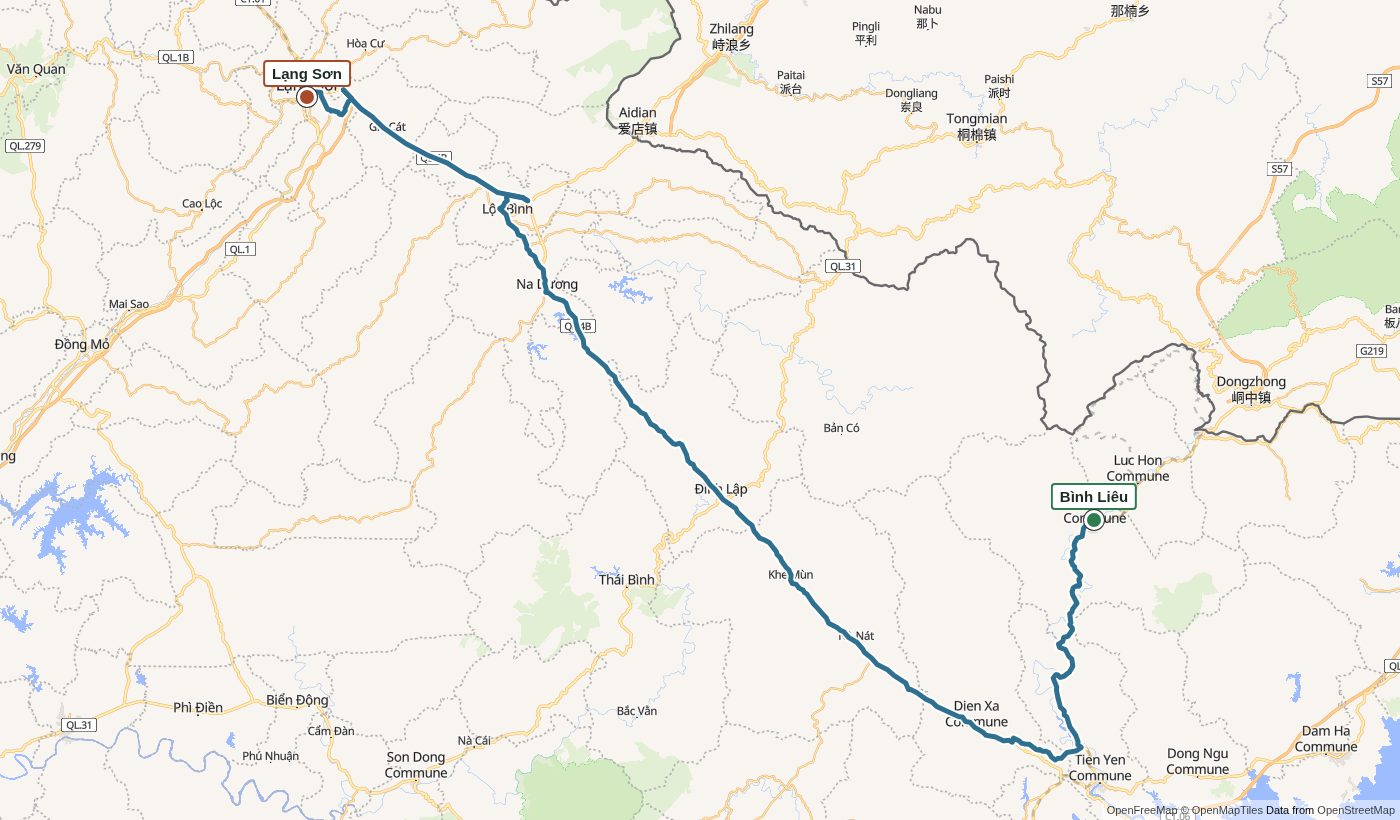
Setting
The road runs west through the Đình Lập and Lộc Bình hills, a land of pine plantations and rolling red earth. It then comes down into the Kỳ Cùng river basin at Lạng Sơn, the main gateway between Hà Nội and China.
Story
For a thousand years invading armies from the north came this way. Chi Lăng pass, about 40 km south of Lạng Sơn, was the place to stop them. Lê Hoàn, Lý Thường Kiệt and Trần Hưng Đạo all fought here. In 1427 Lê Lợi’s men lured a Ming relief army into the pass and killed its commander Liu Sheng, which effectively ended twenty years of Ming occupation. In February–March 1979 Chinese troops attacked across the whole border. They took and briefly held Lạng Sơn before withdrawing on 16 March, leaving much of the town destroyed.
People
Tày, Nùng and Dao. Lạng Sơn is the heartland of the Tày and Nùng, and the market here is famous for roast duck and pork with mắc mật leaves.
What makes it special
Lạng Sơn is a frontier town in the fullest sense, shaped by trade and by war with China for a millennium. The 1979 war is still within living memory for older people.
The peoples in more detail
Along the way: Tày, Nùng, Dao.
Tày (Thổ, old name)
Valley rice farmers who live in timber stilt houses and wear plain indigo-dyed clothes. They are the majority in Bình Liêu and have lived around Ba Bể for about 2,000 years; Pác Ngòi is a Tày village.
Food: Sticky rice was once the staple, and most homes still have a steamer for it.
Nùng
Close relatives of the Tày, with similar stilt houses and plain indigo clothes. Many sub-groups take their names from places in southern China: Nùng An, Nùng Dín, Nùng Phàn Slình and others.
Food: In many places maize is the staple, ground and cooked into a thick porridge.
Dao (Yao, Mien)
A large group with many branches, each with its own dress. In Bình Liêu you'll see Dao Thanh Y and Dao Thanh Phán, around Ba Bể the Dao live on the hillsides, at Bắc Hà market Black Dao come in, and in Sa Pa and Hoàng Su Phì there are Red Dao, with red pom-pom headdresses.
Food: Two main meals a day, of rice or, in some places, maize or rice porridge.
Military history and figures
Military history
Lạng Sơn guards the main invasion road from China.
- Chi Lăng pass, 40 km south. Lê Hoàn, Lý Thường Kiệt, Trần Hưng Đạo and Lê Lợi all fought here. In 1427 Lê Lợi’s army ambushed the Ming relief army and killed its commander Liu Sheng, which ended the Ming occupation.
- 1885. In March the Sino-French War turned when French forces were defeated at Zhennan Pass and Kỳ Lừa and hurriedly abandoned Lạng Sơn. The news helped bring down the Ferry government in Paris.
- 1979. Chinese troops took Lạng Sơn in fierce fighting and withdrew on 16 March, leaving much of the town destroyed. China claims a victory, and Vietnam stresses the defence and the withdrawal.
Linked figures
- Lê Lợi and Liu Sheng.
- General François de Négrier (French) and Feng Zicai (Qing), the commanders of 1885.