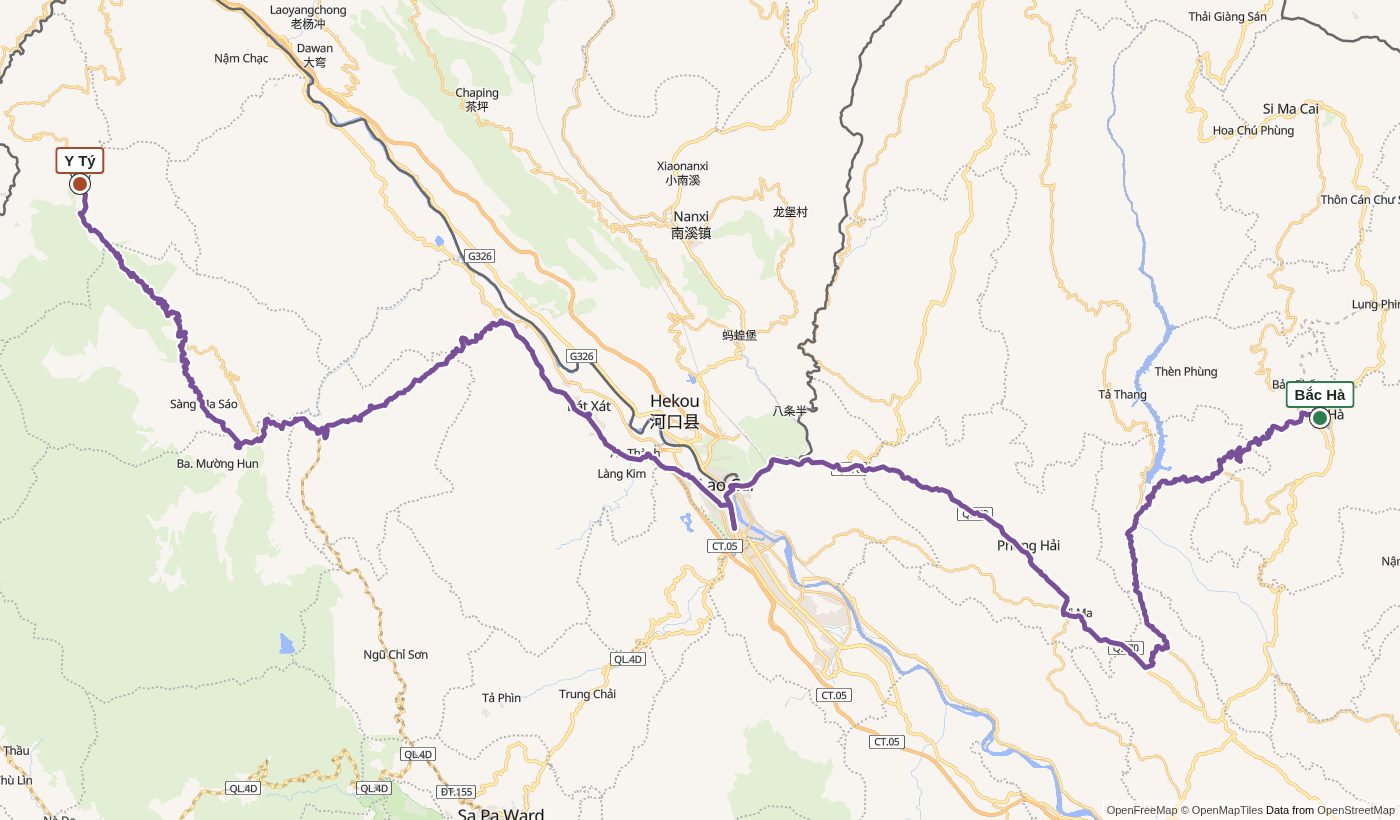
Setting
The road comes down to the Red River at Lào Cai city on the Chinese border, then climbs through Bát Xát to Y Tý. Y Tý is a commune at around 2,000 m below peaks such as Lảo Thẩn (2,860 m).
Story
The Red River enters Vietnam at Lào Cai and the city faces Hekou in Yunnan across the Nậm Thi. It has been a trade gateway for centuries. Lào Cai was also hit hard in the 1979 war. Y Tý is known for “cloud hunting”, seas of cloud over the terraced valleys.
People
Flower Hmong, Phù Lá, Giáy and Dao, then the Black Hà Nhì at Y Tý. They live in earth-walled “mushroom” houses with thatched roofs.
What makes it special
Y Tý is one of the remotest settlements in the north, with Hà Nhì culture still very much alive.
The peoples in more detail
Along the way: Flower Hmong, Phù Lá, Giáy, Dao, Hmong, Black Hà Nhì at Y Tý.
Hmong (H'Mông, Mèo, old name, now avoided)
The people you'll see most in the high country. They make up about 72% of the Đồng Văn plateau and about half of Sa Pa, and Mường Lống is entirely Hmong.
Food: Two meals a day, three at harvest.
Phù Lá (including the Xa Phó)
Hill farmers known for their patterned rattan and bamboo baskets, who come in to the Bắc Hà and Cán Cấu markets. The Xa Phó of Nậm Sài, a Phù Lá sub-group, are Sa Pa's smallest community.
Food: Rice is pounded by hand every day and eaten in two meals, early morning and evening.
Giáy (Nhắng)
Skilled terrace rice farmers. Women wear indigo trousers and a long five-panel jacket that fastens under the right arm, with their hair wound round the head and pink threads at the ends.
Food: Plain rice that is part-boiled and then steamed like sticky rice.
Dao (Yao, Mien)
A large group with many branches, each with its own dress. In Bình Liêu you'll see Dao Thanh Y and Dao Thanh Phán, around Ba Bể the Dao live on the hillsides, at Bắc Hà market Black Dao come in, and in Sa Pa and Hoàng Su Phì there are Red Dao, with red pom-pom headdresses.
Food: Two main meals a day, of rice or, in some places, maize or rice porridge.
Hà Nhì (Hani)
In Lào Cai, the Black Hà Nhì live only in Bát Xát, where they make up about 6% of the population. They build terraces with clever irrigation channels on very steep slopes.
Food: Both sticky and plain rice, with food from hunting, fishing and foraging.
Military history and figures
Military history
- Black Flags. From 1868 Lào Cai was the base of Liu Yongfu’s Black Flag Army. These were Chinese irregulars who controlled the Red River trade and later fought the French for the Huế court, killing Francis Garnier (1873) and Henri Rivière (1883) near Hà Nội.
- 1979. Lào Cai was one of the main axes of the Chinese attack. The town and the bridges were heavily damaged.
Linked figures
- Liu Yongfu (Lưu Vĩnh Phúc, 1837–1917).
Practical notes
- Hà Nhì villages.
- The new part of this track, from Bát Xát onwards, was drawn with a routing service and the road surface has not been checked. Ask locally the evening before.