Setting
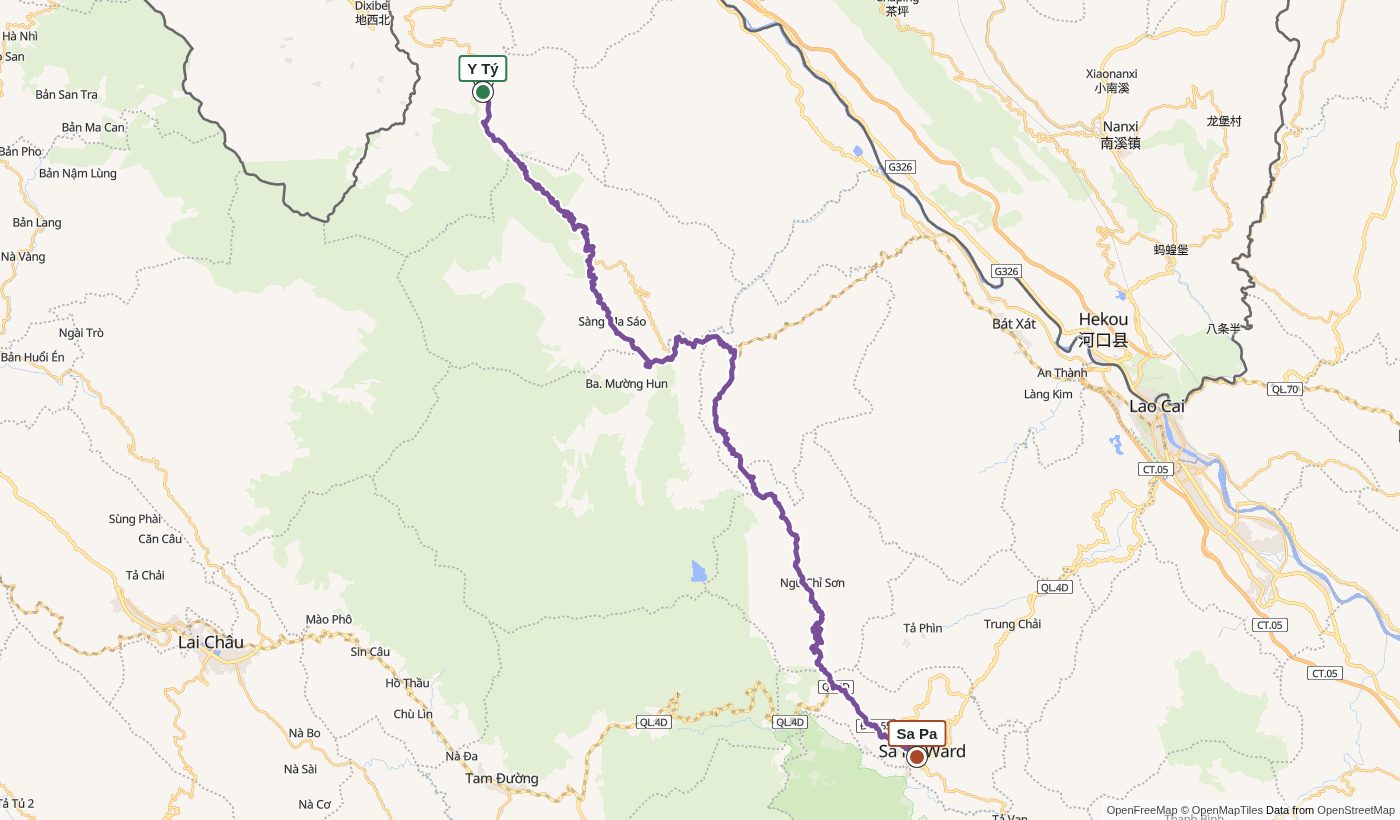
This is a short day. You come down from Y Tý past Bản Xèo and the Mường Hum valley, then climb to Sa Pa at about 1,500 m in the Hoàng Liên Sơn range.
Story
France took control of Tonkin after the Sino-French War of 1885, and the Lào Cai region came under military administration. Sa Pa was developed as a hill station for colonial officials from the early 20th century. The stone church is a reminder of that time.
People
Black Hà Nhì, Hmong, Dao and Giáy (Bản Xèo, Mường Hum).
What makes it special
You move from one of the remotest communes to the north’s best-known resort in a couple of hours. It is a good moment to talk about how tourism has changed the Hmong and Dao villages around Sa Pa.
The peoples in more detail
Along the way: Black Hà Nhì, Hmong, Dao, Giáy (Bản Xèo, Mường Hum).
Hà Nhì (Hani)
In Lào Cai, the Black Hà Nhì live only in Bát Xát, where they make up about 6% of the population. They build terraces with clever irrigation channels on very steep slopes.
Food: Both sticky and plain rice, with food from hunting, fishing and foraging.
Hmong (H'Mông, Mèo, old name, now avoided)
The people you'll see most in the high country. They make up about 72% of the Đồng Văn plateau and about half of Sa Pa, and Mường Lống is entirely Hmong.
Food: Two meals a day, three at harvest.
Dao (Yao, Mien)
A large group with many branches, each with its own dress. In Bình Liêu you'll see Dao Thanh Y and Dao Thanh Phán, around Ba Bể the Dao live on the hillsides, at Bắc Hà market Black Dao come in, and in Sa Pa and Hoàng Su Phì there are Red Dao, with red pom-pom headdresses.
Food: Two main meals a day, of rice or, in some places, maize or rice porridge.
Giáy (Nhắng)
Skilled terrace rice farmers. Women wear indigo trousers and a long five-panel jacket that fastens under the right arm, with their hair wound round the head and pink threads at the ends.
Food: Plain rice that is part-boiled and then steamed like sticky rice.
Military history and figures
Military history
Bát Xát district, on the Red River border, was attacked in 1979. Sa Pa itself grew up as a French hill station and military sanatorium from the early 20th century.
Linked figures
None of national note.
Practical notes
- Short day after the Y Tý night. Mường Hum is a short detour off this road.
- The new part of this track, as far as Bản Xèo, was drawn with a routing service and the road surface has not been checked. Ask locally the evening before.