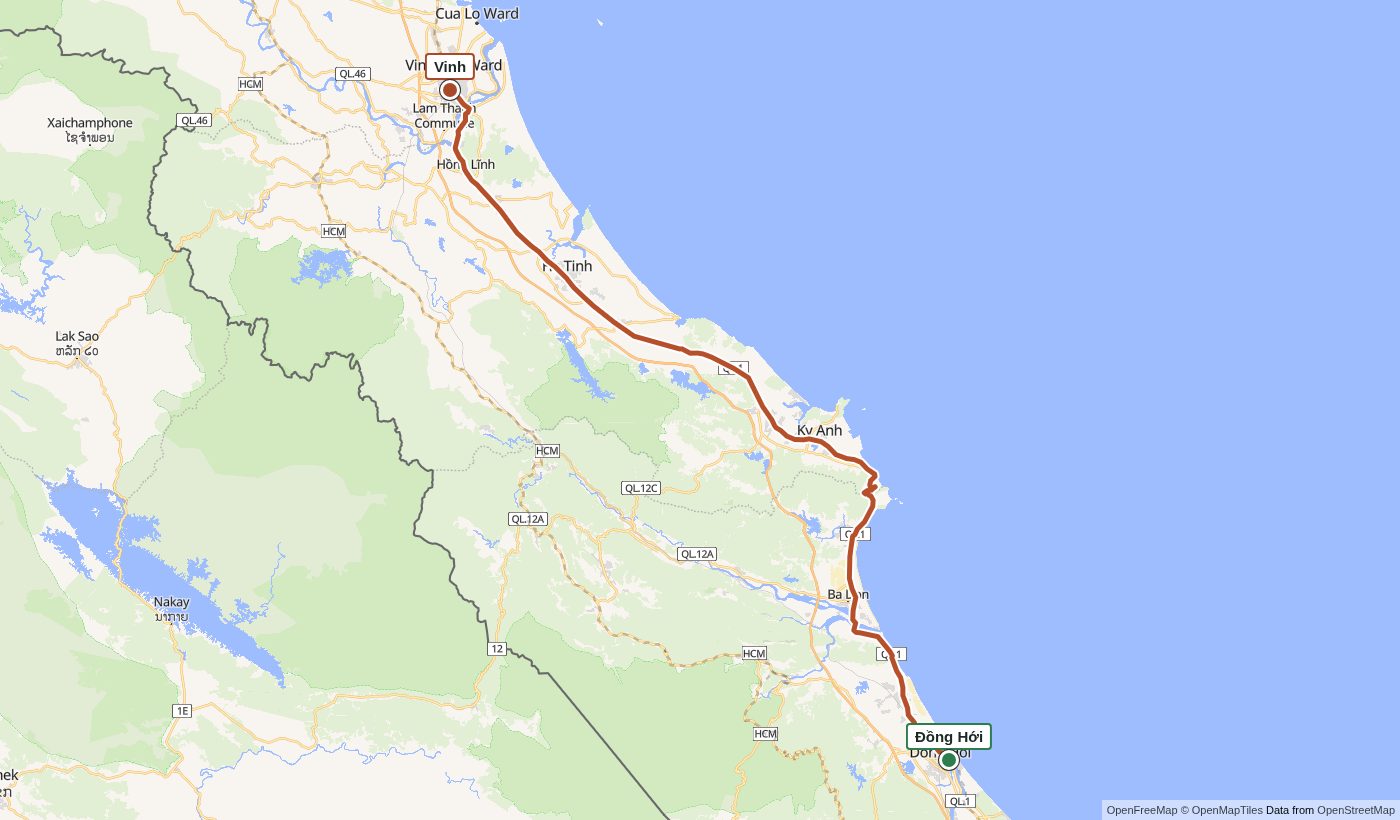
Setting
The road runs north across the Gianh river and climbs the Hoành Sơn range at Đèo Ngang. This is another spur of the Annamites that runs east into the sea. It leads into Hà Tĩnh and then across the Lam (Cả) river into Vinh.
Story
A road over Đèo Ngang is recorded as early as 992. The pass is tied to the 16th-century prophecy that sent Nguyễn Hoàng south to found the Nguyễn domain. “One strip of Hoành Sơn shelters ten thousand generations.” Hoành Sơn Quan, the Nguyễn-era gate on the summit, controlled the north–south mandarin road. Just before Vinh, Nghi Xuân was the family home of Nguyễn Du (1765–1820). He wrote the “Tale of Kiều”, the best-loved poem in the Vietnamese language, and his memorial site is a few kilometres off the road. Vinh itself was almost wiped out by US bombing between 1964 and 1973. It was then rebuilt with East German help as a model socialist city. The Quang Trung housing blocks are the most visible legacy.
People
Kinh. The people of Nghệ An and Hà Tĩnh (“xứ Nghệ”) are known for their strong accent, their frugality and a long tradition of scholars and revolutionaries.
What makes it special
Vinh is a rare piece of East German urban planning in the tropics. Its hinterland produced both Vietnam’s national poet and its revolutionary leader: Hồ Chí Minh’s home village of Kim Liên is 12–15 km west of the city.
The peoples in more detail
Along the way: Kinh.
Kinh (Việt)
The majority people, about 85% of the country. In the mountain towns most shopkeepers and officials are Kinh.
Food: Wet rice is the foundation of everything.
Military history and figures
Military history
- Gianh river. Between 1627 and 1672 the Trịnh and the Nguyễn fought seven major campaigns across the Gianh and the walls south of it, none of them decisive. The river remained the border between Đàng Ngoài and Đàng Trong for about a century.
- Đèo Ngang. The Nguyễn-era Hoành Sơn Quan gate guarded the pass.
- Vinh. The city was bombed almost flat in 1964–73.
- Phượng Hoàng Trung Đô. In 1788 Quang Trung began a citadel here and gathered an army of about 100,000 at Vinh before marching north against the Qing.
Linked figures
- Nguyễn Hoàng (1525–1613), founder of the Nguyễn domain, who crossed the Hoành Sơn on the advice of Nguyễn Bỉnh Khiêm.
- Võ Nguyên Giáp, buried in 2013 by his wish at Vũng Chùa–Đảo Yến in Quảng Trạch, just south of Đèo Ngang and a short detour from the road.
- Quang Trung (Nguyễn Huệ, 1753–1792).
- Nguyễn Du (1765–1820), the poet, from Tiên Điền in Nghi Xuân. He was not a soldier, but his family served the Lê–Trịnh.