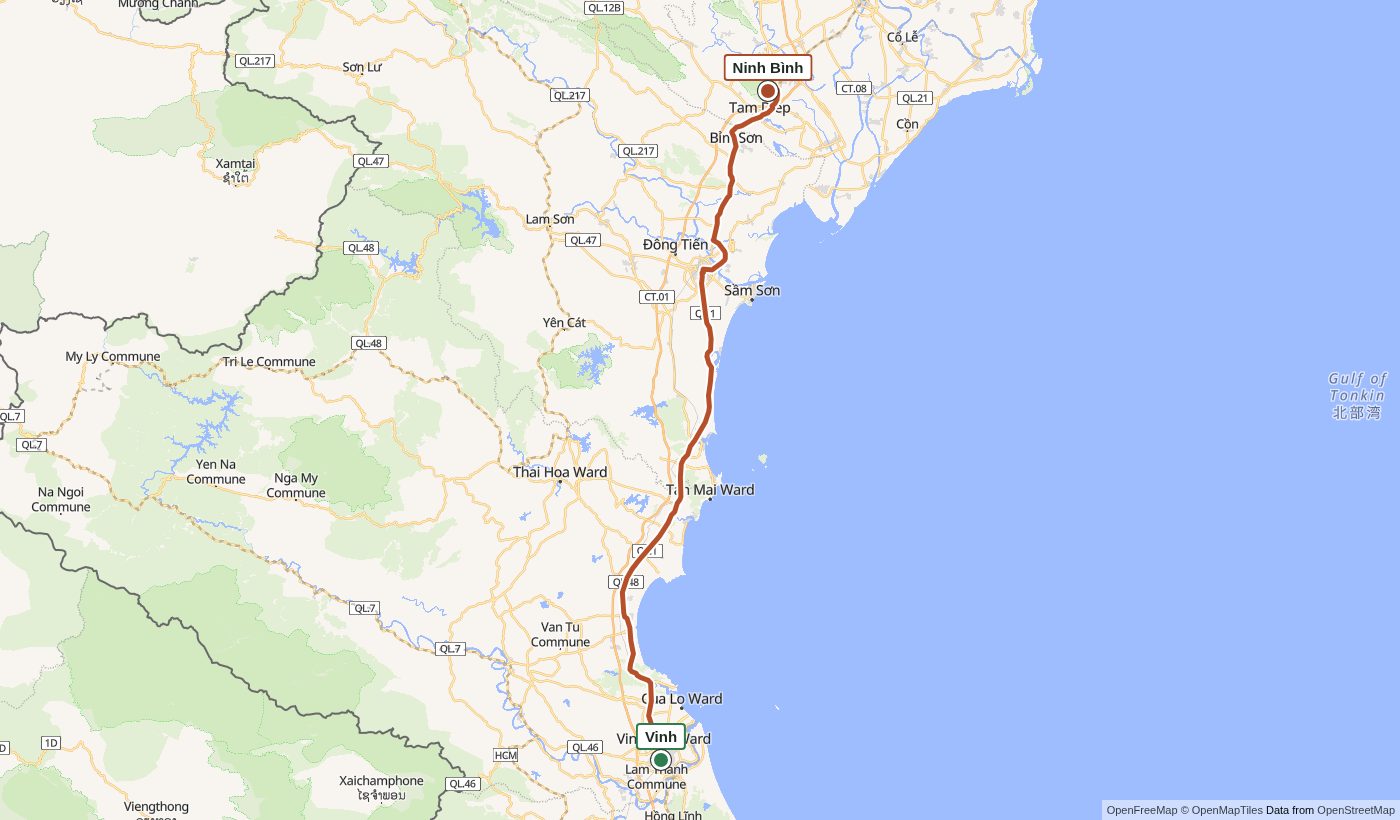
Setting
The road continues north through Nghệ An and the coastal strip of Thanh Hóa and crosses the Mã river at Thanh Hóa city. It then passes through the low limestone barrier of the Tam Điệp hills into the Red River delta at Ninh Bình.
Story
Vinh was the cradle of the 1930–31 Nghệ–Tĩnh Soviets. Starting with strikes at Bến Thủy on 1 May 1930, peasants’ councils briefly took over village government across Nghệ An and Hà Tĩnh. At Thanh Hóa the Hàm Rồng (“Dragon’s Jaw”) bridge over the Mã river became a symbol of the air war. It survived repeated raids from April 1965 until it was brought down with guided bombs in 1972. The Tam Điệp hills mark the old natural boundary between the north and the centre. In 1788–89 Quang Trung (Nguyễn Huệ) used the Tam Điệp line as his base before routing the Qing army at Tết 1789.
People
Kinh on the plain, with Mường villages in the hills west of Ninh Bình and Thanh Hóa.
What makes it special
Today you move from the “centre” into the “north” proper. The change shows in the landscape, from coastal plain to limestone towers, and in the history, as you pass from the Nguyễn heartland into the old core of Đại Việt.
The peoples in more detail
Along the way: Kinh; Mường in the hills near Ninh Bình.
Kinh (Việt)
The majority people, about 85% of the country. In the mountain towns most shopkeepers and officials are Kinh.
Food: Wet rice is the foundation of everything.
Mường
The closest relatives of the Kinh, sharing the same root language. Mai Châu is a mix of Thái and Mường, and Bá Thước is one of the old Mường heartlands.
Food: Steaming is the signature technique: sticky rice, plain rice, greens and fish are all steamed.
Military history and figures
Military history
- Nghệ–Tĩnh Soviets. In 1930–31 the French put the movement down with troops and air attacks.
- Hậu Lộc. In 248 AD Lady Triệu (Bà Triệu) led a rising against the Wu (Ngô) occupation in the hills of Thanh Hóa. She died on Mount Tùng in Hậu Lộc, close to QL1, where her temple stands.
- Hàm Rồng bridge. The bridge was defended through repeated air raids from April 1965 until it was brought down in 1972.
- Tam Điệp line. In 1788–89 this was the Tây Sơn defensive line before Quang Trung’s Tết offensive that destroyed the Qing army at Ngọc Hồi–Đống Đa.
Linked figures
- Bà Triệu (Triệu Thị Trinh, c. 226–248).
- Ngô Thì Nhậm, who chose the Tam Điệp line.
- Quang Trung.