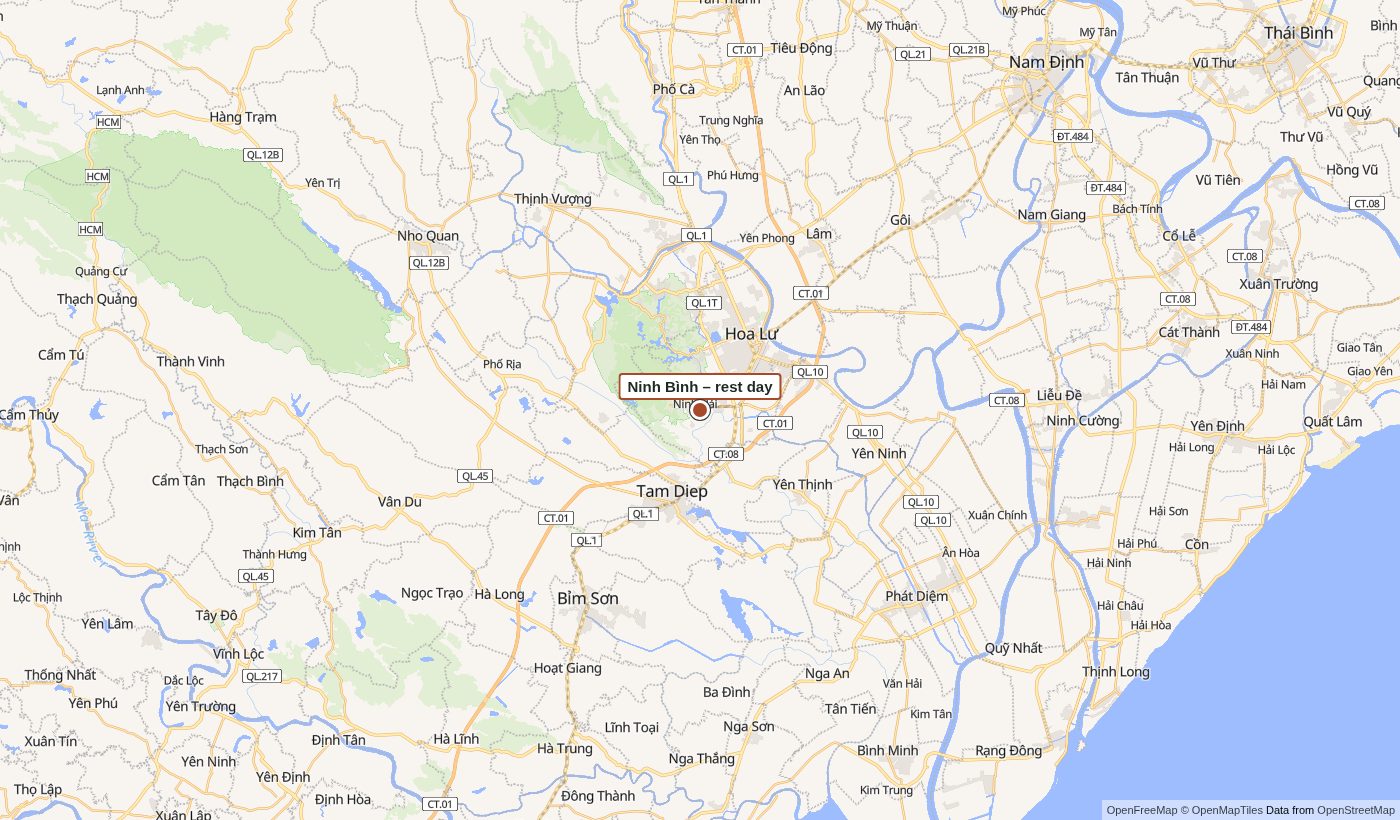
Setting
This is a drowned karst landscape: limestone towers rising from flooded valleys, rivers that run straight through caves, and rice fields between the peaks.
Story
Hoa Lư was the capital of independent Vietnam (Đại Cồ Việt) from 968 to 1010. Đinh Tiên Hoàng chose it after defeating the “twelve warlords”, because the ring of karst made a natural fortress. The Early Lê dynasty and the first Lý king ruled here until the capital moved to Thăng Long (Hà Nội) in 1010. In 2014 UNESCO inscribed the Tràng An Landscape Complex, which includes Hoa Lư, Tràng An, Tam Cốc and Bích Động and the Hoa Lư forest. It was Vietnam’s first mixed cultural and natural World Heritage Site, and the first in Southeast Asia.
People
Kinh, with Mường in the western hills.
What makes it special
Tràng An is listed for its culture, its scenery and its geology at the same time. Archaeologists have also found evidence of human occupation in its caves going back tens of thousands of years. A rowing-boat trip through the cave-tunnels at Tràng An is the classic rest-day outing.
The peoples in more detail
Along the way: Kinh; Mường in the nearby hills.
Kinh (Việt)
The majority people, about 85% of the country. In the mountain towns most shopkeepers and officials are Kinh.
Food: Wet rice is the foundation of everything.
Mường
The closest relatives of the Kinh, sharing the same root language. Mai Châu is a mix of Thái and Mường, and Bá Thước is one of the old Mường heartlands.
Food: Steaming is the signature technique: sticky rice, plain rice, greens and fish are all steamed.
Military history and figures
Military history
- Hoa Lư. The karst ring made Hoa Lư a natural fortress, which is why Đinh Bộ Lĩnh chose it as his capital after defeating the twelve warlords in 968.
- Song invasion of 981. Lê Hoàn led Đại Cồ Việt’s armies out from Hoa Lư by river against the Song. He defeated the invasion on land and on the Bạch Đằng.
Linked figures
- Đinh Tiên Hoàng (Đinh Bộ Lĩnh, 924–979).
- Lê Hoàn (Lê Đại Hành, 941–1005).
- Lý Công Uẩn (Lý Thái Tổ), who moved the capital from Hoa Lư to Thăng Long in 1010.