Setting
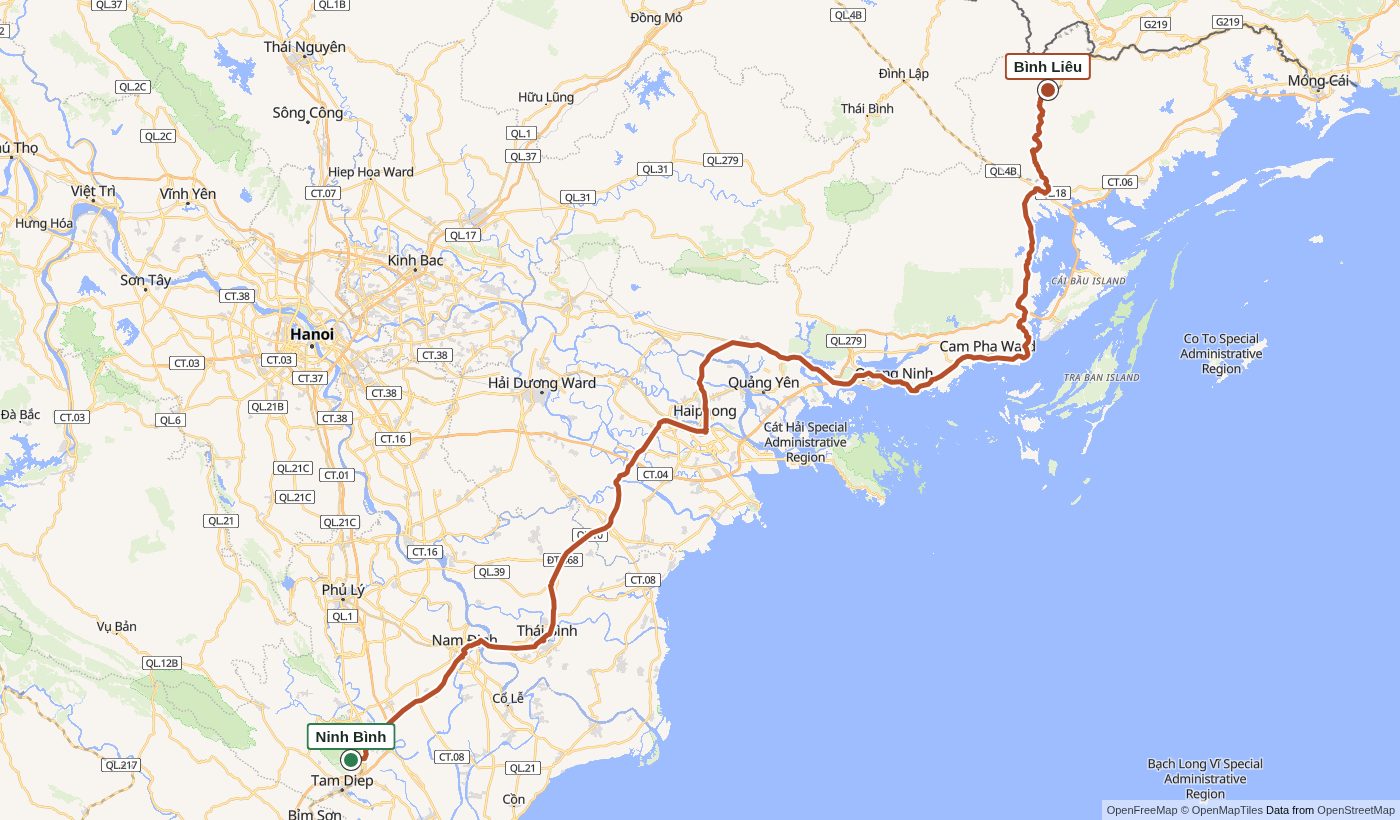
You cross the eastern Red River delta through Thái Bình and Hải Phòng. The road then follows the coast of Quảng Ninh past Hạ Long Bay and turns inland at Tiên Yên, climbing into the hills along the Chinese border. You could split the day at Hạ Long (194 km + 109 km).
Story
Hạ Long Bay and the Cát Bà archipelago together form a World Heritage Site of 1,133 limestone islands and islets. It was first inscribed in 1994 and was extended to include Cát Bà in 2023. Quảng Ninh is also Vietnam’s coal province: the open-cast mines around Cẩm Phả, which date from French times, are visible from the road.
People
Kinh on the coast, then Tày, Dao and Sán Chỉ as you climb towards Bình Liêu.
What makes it special
This is the transition from the sea to the border mountains in one afternoon. Few places in Vietnam show it so sharply.
The peoples in more detail
Along the way: Kinh, then Tày, Dao and Sán Chỉ around Bình Liêu.
Kinh (Việt)
The majority people, about 85% of the country. In the mountain towns most shopkeepers and officials are Kinh.
Food: Wet rice is the foundation of everything.
Tày (Thổ, old name)
Valley rice farmers who live in timber stilt houses and wear plain indigo-dyed clothes. They are the majority in Bình Liêu and have lived around Ba Bể for about 2,000 years; Pác Ngòi is a Tày village.
Food: Sticky rice was once the staple, and most homes still have a steamer for it.
Dao (Yao, Mien)
A large group with many branches, each with its own dress. In Bình Liêu you'll see Dao Thanh Y and Dao Thanh Phán, around Ba Bể the Dao live on the hillsides, at Bắc Hà market Black Dao come in, and in Sa Pa and Hoàng Su Phì there are Red Dao, with red pom-pom headdresses.
Food: Two main meals a day, of rice or, in some places, maize or rice porridge.
Sán Chỉ (officially part of the Sán Chay)
About 15% of people in Bình Liêu. They live in stilt houses much like their Tày neighbours'.
Food: Mostly plain rice, with plenty of rice wine at festivals.
Military history and figures
Military history
The road crosses Hải Phòng and the Quảng Yên–Uông Bí area, on the estuary of the Bạch Đằng river. It is the site of three famous river battles.
- 938. Ngô Quyền planted iron-tipped stakes in the riverbed and destroyed the Southern Han fleet at low tide, ending a thousand years of Chinese rule.
- 981. Lê Hoàn fought the Song here.
- 1288. On 9 April Trần Hưng Đạo used the same stake tactic to destroy the Mongol (Yuan) fleet. Stake fields survive at Quảng Yên, and some stakes are now in the National Museum of History.
- Hải Phòng, 1946. On 23 November the French navy bombarded Hải Phòng’s Vietnamese quarters, killing thousands. This is generally seen as the start of the First Indochina War.
Linked figures
- Ngô Quyền (897–944).
- Trần Hưng Đạo (Trần Quốc Tuấn, c. 1228–1300).
Practical notes
- Option: break the day with a night at Hạ Long (194 km, then 109 km).