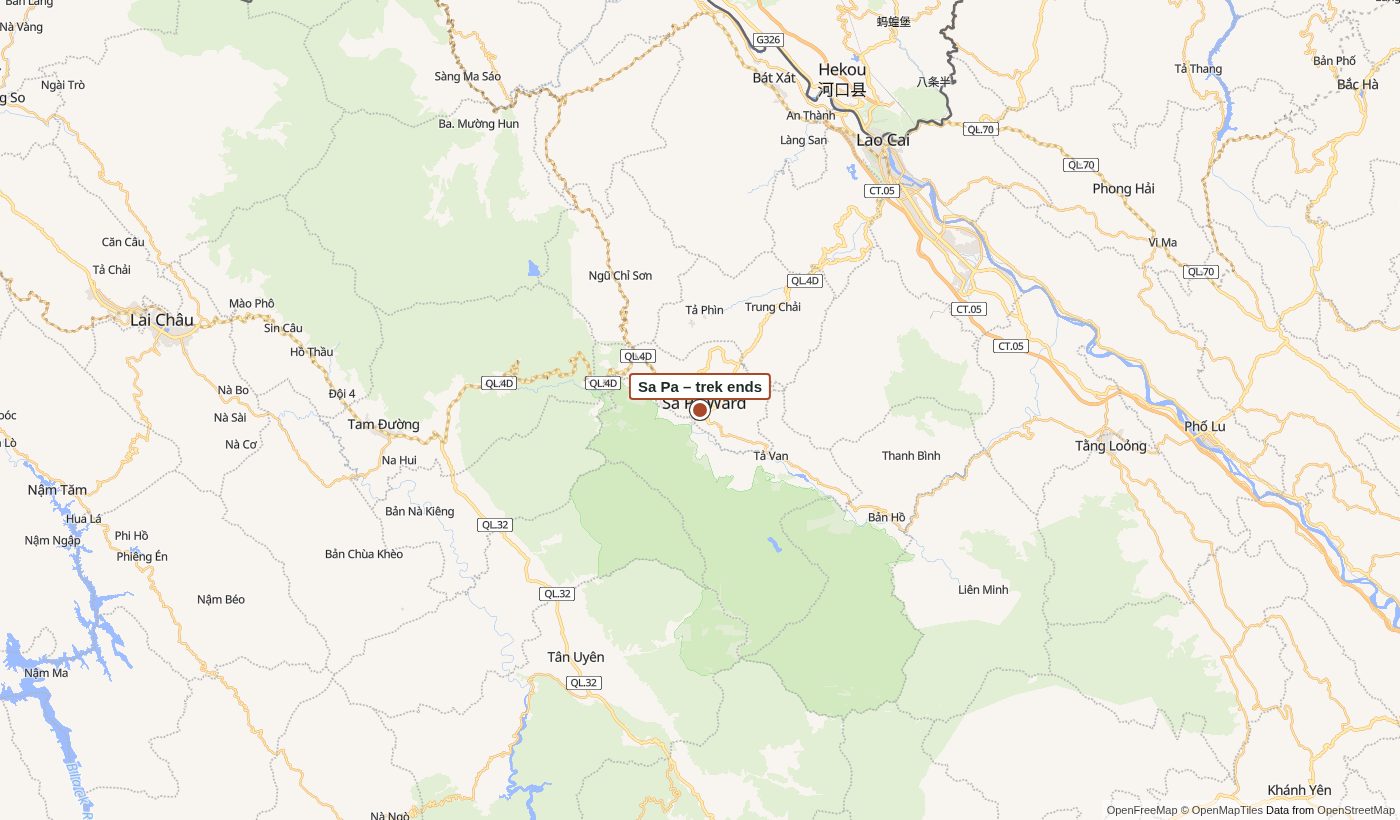
Setting
The trail climbs back out of the valleys towards Sa Pa.
Story
Sa Pa’s market and town centre fill up at weekends and on public holidays.
People
Black Hmong, Red Dao, Giáy, Tày and Xa Phó.
What makes it special
Use the afternoon for indigo dyeing and batik in a Hmong or Dao workshop. These skills still survive alongside the tourist trade.
The peoples in more detail
Along the way: Black Hmong, Red Dao, Giáy, Tày, Xa Phó.
Hmong (H'Mông, Mèo, old name, now avoided)
The people you'll see most in the high country. They make up about 72% of the Đồng Văn plateau and about half of Sa Pa, and Mường Lống is entirely Hmong.
Food: Two meals a day, three at harvest.
Dao (Yao, Mien)
A large group with many branches, each with its own dress. In Bình Liêu you'll see Dao Thanh Y and Dao Thanh Phán, around Ba Bể the Dao live on the hillsides, at Bắc Hà market Black Dao come in, and in Sa Pa and Hoàng Su Phì there are Red Dao, with red pom-pom headdresses.
Food: Two main meals a day, of rice or, in some places, maize or rice porridge.
Giáy (Nhắng)
Skilled terrace rice farmers. Women wear indigo trousers and a long five-panel jacket that fastens under the right arm, with their hair wound round the head and pink threads at the ends.
Food: Plain rice that is part-boiled and then steamed like sticky rice.
Tày (Thổ, old name)
Valley rice farmers who live in timber stilt houses and wear plain indigo-dyed clothes. They are the majority in Bình Liêu and have lived around Ba Bể for about 2,000 years; Pác Ngòi is a Tày village.
Food: Sticky rice was once the staple, and most homes still have a steamer for it.
Phù Lá (including the Xa Phó)
Hill farmers known for their patterned rattan and bamboo baskets, who come in to the Bắc Hà and Cán Cấu markets. The Xa Phó of Nậm Sài, a Phù Lá sub-group, are Sa Pa's smallest community.
Food: Rice is pounded by hand every day and eaten in two meals, early morning and evening.
Military history and figures
This area is covered on Day 20.
Practical notes
- Trek ends, no riding.