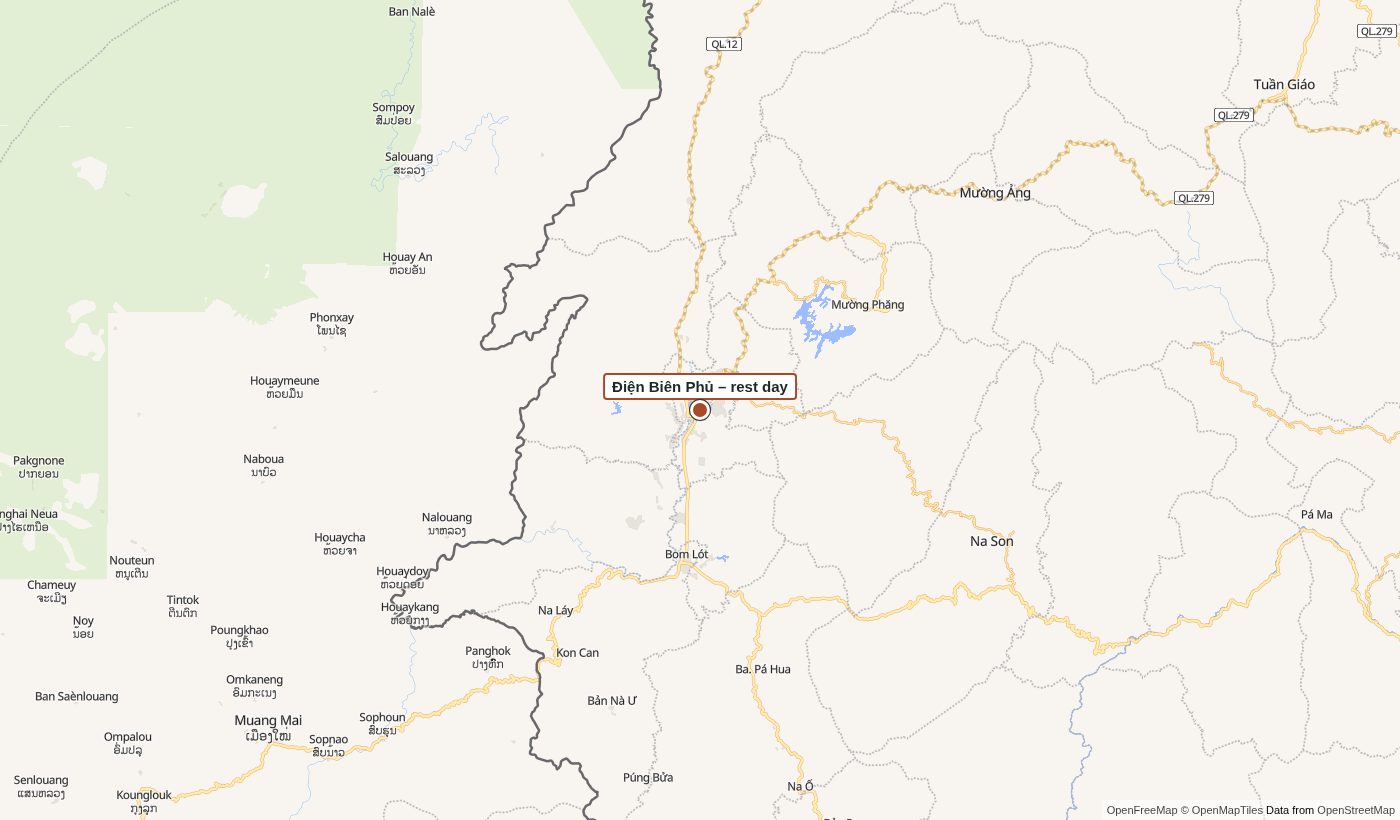
Setting
The Mường Thanh valley is the largest basin in the north-west, about 20 km long, surrounded by hills. It has been a rice bowl for the Thái for centuries.
Story
From 13 March to 7 May 1954 the Việt Minh besieged the French entrenched camp. Hill A1 (“Eliane 2” to the French) was the key position on the eastern hills, only about 300 m from the French command post. It was fought over from 30 March and fell on the night of 6–7 May after a huge mine was exploded beneath it. De Castries surrendered the same day. The guns had been hauled by hand over Pha Đin and the surrounding mountains.
People
Black Thái, Lào, Khơ Mú and Hmong.
What makes it special
You can visit Hill A1, the de Castries bunker and the museum in a single day.
The peoples in more detail
Along the way: Black Thái, Lào, Khơ Mú, Hmong.
Thái (Tai Dam, Tai Don)
This is the people of the Days 16–24 valleys. Black Thái live around Sơn La and Điện Biên, and White Thái around Mai Châu.
Food: Sticky rice steamed in a wooden steamer is the traditional staple, though plain rice is now the everyday grain.
Lào
A small community near the Lao border, one of the 19 groups in Điện Biên province. They are fine potters, using the wheel, and also weave brocade and work silver.
Food: Mainly sticky rice and fish, including the well-known fermented fish pàđẹc.
Khơ Mú (Khmu)
Upland farmers known for their fine basketry in bamboo and rattan. They are about 3% of Điện Biên and the largest group in Kỳ Sơn, at about 36%.
Food: Steamed sticky rice or steamed maize, often bulked out with cassava.
Hmong (H'Mông, Mèo, old name, now avoided)
The people you'll see most in the high country. They make up about 72% of the Đồng Văn plateau and about half of Sa Pa, and Mường Lống is entirely Hmong.
Food: Two meals a day, three at harvest.
Military history and figures
Military history
- The siege, 1954. From 13 March to 7 May 1954 the Việt Minh besieged and took the French entrenched camp in the valley, the decisive battle of the First Indochina War.
- The battlefield. You can see Hill A1, fought over from 30 March to 6 May, de Castries’ command bunker, the museum and the cannon-hauling routes over the surrounding mountains.
- “Fight steadily, advance steadily”. In late January Giáp abandoned the plan for a quick assault and pulled the guns back out. He called this the hardest decision of his career.
- Bản Phủ citadel. Much older is the citadel at Bản Phủ, built in the 18th century by Hoàng Công Chất, who led a peasant rising and drove out the Phẻ raiders from Laos.
Linked figures
- Võ Nguyên Giáp.
- Colonel (later General) Christian de Castries, the French commander.
- Heroes Tô Vĩnh Diện, who died on 1 February 1954 throwing himself under a runaway gun; Phan Đình Giót, who covered a firing slit with his body; and Bế Văn Đàn.
- Hoàng Công Chất (d. 1769).