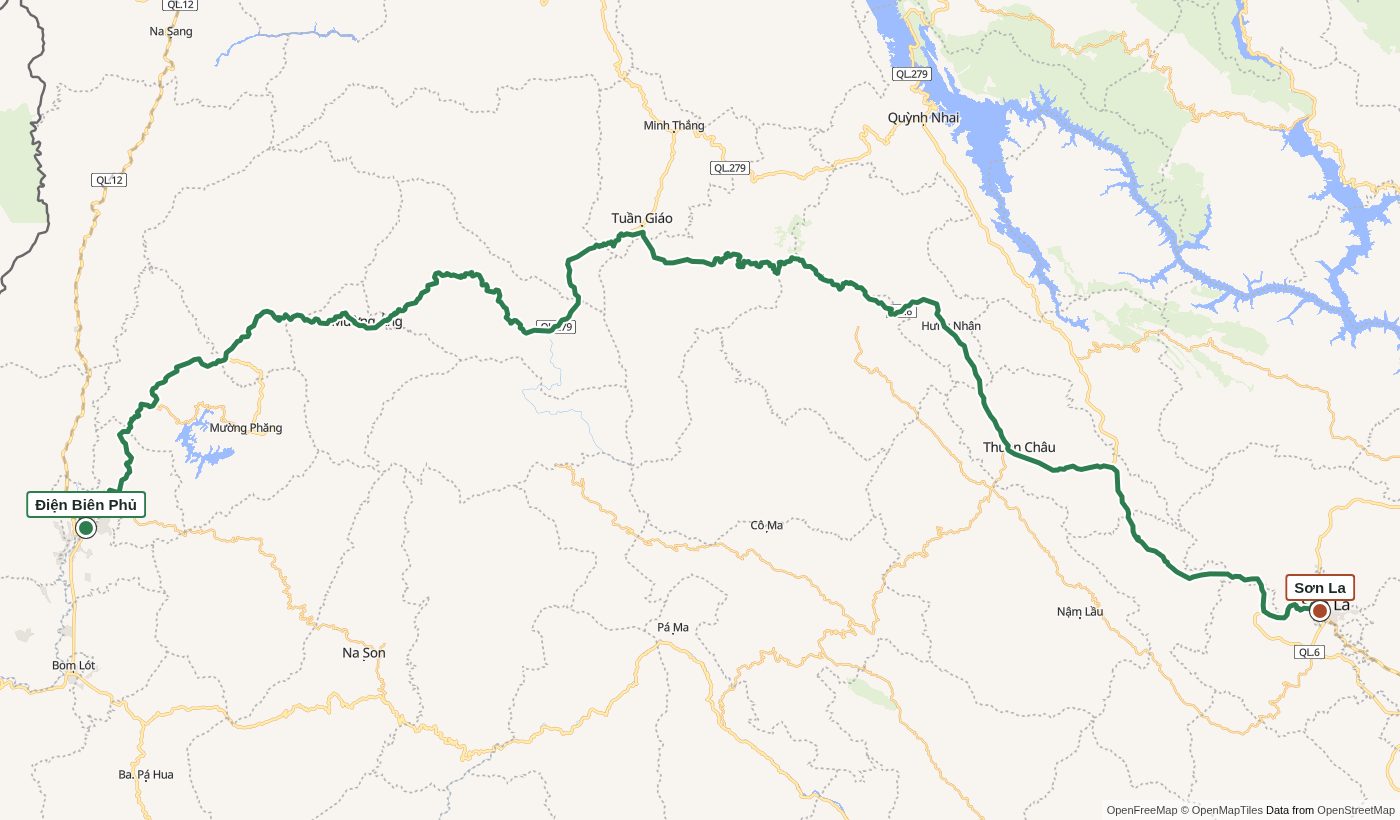
Setting
The road is QL6 by way of Tuần Giáo, the Pha Đin pass and Thuận Châu. This is the old main road of the north-west, crossing the Thái uplands.
Story
Pha Đin, between Điện Biên and Sơn La, took thousands of tonnes of bombs in 1954 as it carried supplies to the siege. It is one of the “four great passes”. Sơn La prison, on Khau Ca hill, was built by the French in 1908. Between 1930 and 1945 it held 1,013 political prisoners, including later leaders such as Lê Duẩn, Trường Chinh and Tô Hiệu, and it became a “school” for revolutionaries.
People
Black Thái, Khơ Mú, Hmong and Xinh Mun.
What makes it special
You follow the main supply road of 1954 and end at the prison where many of the people who ran it were trained.
The peoples in more detail
Along the way: Black Thái, Khơ Mú, Hmong, Xinh Mun.
Thái (Tai Dam, Tai Don)
This is the people of the Days 16–24 valleys. Black Thái live around Sơn La and Điện Biên, and White Thái around Mai Châu.
Food: Sticky rice steamed in a wooden steamer is the traditional staple, though plain rice is now the everyday grain.
Khơ Mú (Khmu)
Upland farmers known for their fine basketry in bamboo and rattan. They are about 3% of Điện Biên and the largest group in Kỳ Sơn, at about 36%.
Food: Steamed sticky rice or steamed maize, often bulked out with cassava.
Hmong (H'Mông, Mèo, old name, now avoided)
The people you'll see most in the high country. They make up about 72% of the Đồng Văn plateau and about half of Sa Pa, and Mường Lống is entirely Hmong.
Food: Two meals a day, three at harvest.
Xinh Mun
One of Sơn La's smaller upland groups. They dress like their Thái neighbours and live in stilt houses with roofs rounded like a turtle shell.
Food: Sticky and plain rice, spicy food and jar wine.
Military history and figures
Military history
- Pha Đin pass. In 1953–54 this was the key chokepoint on the Việt Minh supply line to Điện Biên Phủ. The French bombed it constantly, and youth volunteers and porters kept it open.
- Sơn La prison. The French built the prison in 1908 and enlarged it in 1930. It held hundreds of political prisoners, and many of them later became leaders of the revolution.
Linked figures
- Tô Hiệu (1912–1944), the prison’s party secretary. He died there, and the peach tree he planted is still shown.
- Lê Duẩn and Trường Chinh, both former inmates.